Monday, 6 January 2020

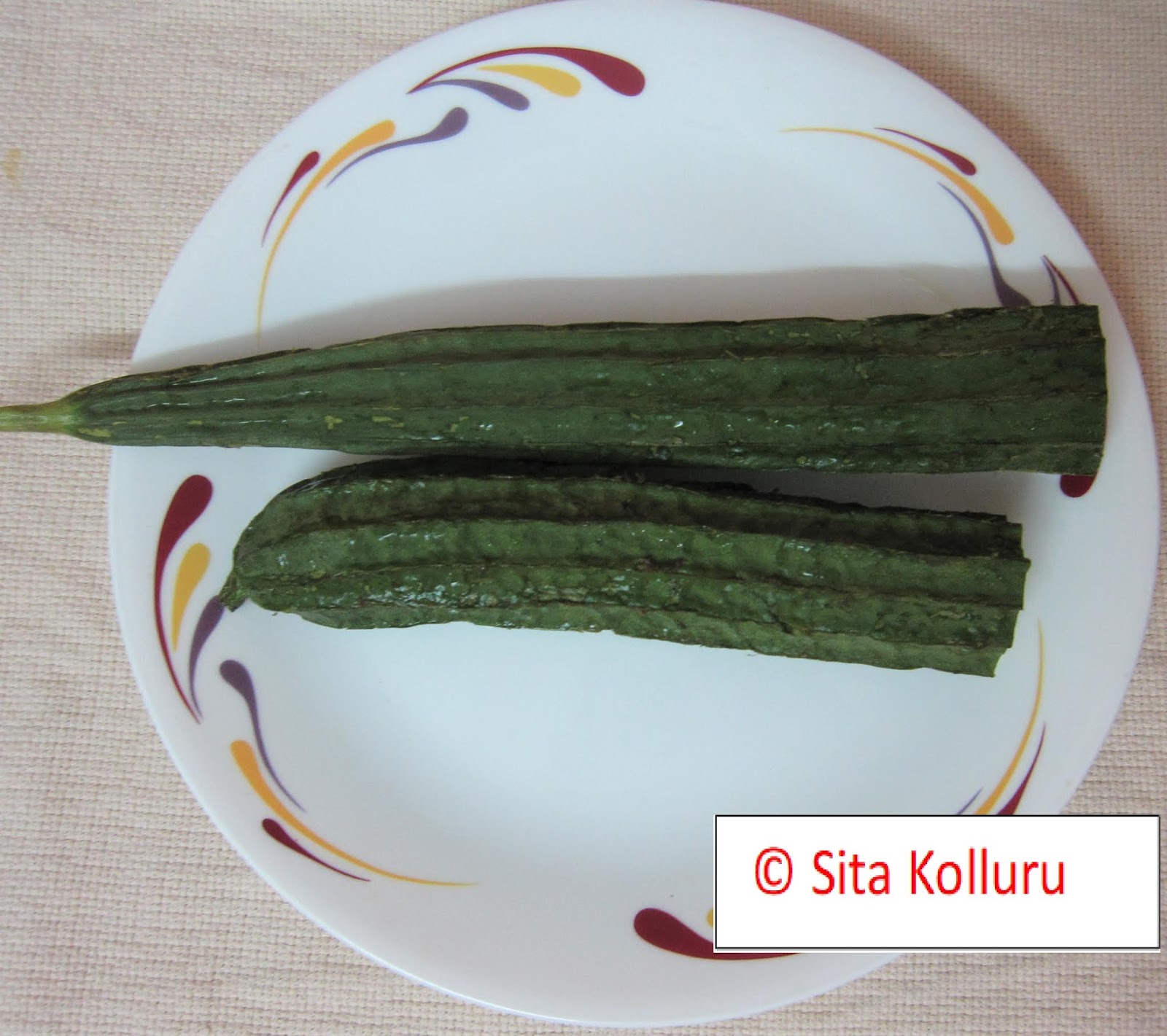
Beerakaya pottu pacchadi (Ridge gourd/Taroi peel chutney)

Beerakaya or taroi as it is known in Hindi is Ridge gourd or sponge gourd. It is referred to as Luffa also. It is a ridged and dark green vegetable with white pulp inside. The fruit of this species is eaten as a vegetable. This vegetable is popular in India, China and Vietnam.

When the fruit is fully ripened, it is very fibrous. The very ripe fruit is dehydrated and processed to remove everything except the network of fibers. The fibrous skeleton is marketed as luffa or loofah sponge, which is used as a body scrub, or scrubbing sponge for kitchen cleaning etc.

For edible purposes, the gourd has to be very tender, before hard seeds and fiber develop. The taste of the vegetable resembles zucchini.

Beerakaya has a lot of health benefits. some of the benefits are as below.

It is rich in dietary fiber and includes vitamin C, zinc, iron, riboflavin, magnesium etc. The vegetable is low in saturated fat, cholesterol and calories which aids in weight loss. Taroi contains good amount of cellulose and high in water content that helps to relieve from constipation. Some more benefits are reducing sugar levels, improving eye sight, purifying blood etc.

In Andhra beerakaya is a popular sick diet for convalescent people or young mothers after delivery etc. A variety of subzis, dals, chutneys etc. are made using beerakaya. Here is a recipe for a tasty chutney. In this chutney, the main item is the peel of the vegetable. The chutney is full of fiber. Also, the healthy peel is not discarded. Adding walnuts enhances both the taste and nutritive value of the chutney.


Ingredients:


  •      1 cup beerakaya peel
  •      1/2 cup diced beerakaya
  •      2 Tbsp. walnuts
  •      2 Tsp. oil
  •      2 or 3 green chiles
  •      1 Tsp. red chile powder
  •      1/2 Tsp. turmeric powder
  •      Salt to taste
  •      1 Tsp. mustard methi powder
  •      2 Tsp. lemon juice
  •      Cilantro

Seasoning:

  •      1 Tsp. oil
  •      1 Tsp. mustard seeds
  •      1/2 Tsp. chana dal
  •      1/2 Tsp. urad dal
  •      Pinch of hing (asafetida)

Directions:

  1.      Wash and peel beerakaya (taroi/ridge gourd)
  2.      Save the peel.
  3.      Finely chop the peel.
  4.      If very little peel is available, some diced beerakaya can be added.
  5.      If you are using lot of the beerakaya for some other subzi etc. only the peel itself can be used.
  6.      Heat oil in a thick pan.
  7.      Add the peel and the diced pieces.
  8.      Let it cook on low heat for 4 to 5 minutes.
  9.      When the pieces are all soft to touch, stop cooking.
  10.      Let the mixture cool.
  11.      Add the walnut pieces, green chiles, some cilantro and the powder ingredients and grind in a mixer.
  12.      Add lemon juice and mix well.
  13.      Transfer to a bowl.
  14.      Heat oil in a pan for seasoning.
  15.      Add dals and mustard seeds and pour the hot seasoning over the chutney.
  16.      Garnish with cilantro and serve.


Note:  Adding walnuts is optional. The taste and nutritive value are enhanced by the addition of walnuts. In place of walnut, roasted sesame seeds can be added.


Sunday, 17 November 2019

Gummadikaya (kaddu) halwa (Red pumpkin halwa)

Gummadikaya (pumpkin) is a popular vegetable in many countries.

In India all over the country gummadikaya is available. In many areas it is used in festive occasions like weddings and house warming functions. Either a subzi or a pulusu (mixed vegetable sweet and sour stew) cooked with pumpkin is definitely served in festive lunches.

Similarly in North America and Canada pumpkin pie is a traditional part of Thanksgiving meals. From middle of September, one finds many kinds of pumpkins all over USA. Pumpkins have a lot of significance in Halloween folklore.

Pumpkin leaves, flowers and seeds are edible.

Pumpkin has a lot of medicinal value also. Pumpkin is highly nutritious and very rich in vitamin A.
It is contains high amount of antioxidants and may reduce risk of chronic diseases and boost immunity. Pumpkin is high in nutrient density and low in calories. Consuming pumpkin may help in weight loss.

Some people may be allergic to pumpkin. Also, it is mildly diuretic, which means eating a lot of pumpkin may induce production of more urine.

In USA and Canada you find pumpkin pie, pumpkin bread and even pumpkin latte! In India lot of subzis and sweets are made with pumpkin. Here is a recipe for pumpkin halwa. Very little sugar and ghee (clarified butter) are used, so that it is not overly rich!

This festive season, try out this halwa for your holidays!


Ingredients:


  •      3 cups grated pumpkin
  •      3/4 cup sugar 
  •      1 or 2 Tbs, sooji (cream of wheat)
  •      2 Tbs. ghee (clarified butter)
  •      2 Tbs. cashew nuts
  •      1 Tbs. raisins
  •      4 or 5 green cardamom 

Directions:

  1.      Wash and cut the pumpkin in half.
  2.      Remove seeds and inside pulp.
  3.      Peel the skin off.
  4.      Either you can grate them  or
  5.      Cut in to one inch pieces.
  6.      Process the pieces and a vegetable chopper.
  7.      Grind in a powder grinder or pestle and mortar cardamom seeds.
  8.      Heat a thick pan. 
  9.      Add ghee.
  10.      When the ghee melts, add cashews and cook for 2 minutes.
  11.      When cashews are turning brown, add raisins.
  12.      Remove them from the pan and set aside.
  13.      To the same pan, add sooji.
  14.      Keep stirring so that sooji is not burnt.
  15.      After 2 or 3 minutes, add grated/processed pumpkin.
  16.      On low heat cook for 5 to 6 minutes.
  17.      Keep stirring.
  18.      When the moisture is almost evaporated, add sugar.
  19.      After adding sugar, more moisture will be there.
  20.      Keep stirring till the mixture becomes compact and leaves the sides and bottom of the pan.
  21.      When touched, the mixture does not stick to the fingers.
  22.      At this stage, the halwa is ready.
  23.      Add cardamom powder and nuts.
  24.      Mix well. 
  25.      Transfer to serving bowl and serve hot.
  26.      Tastes nice whether eaten hot or refrigerated. 


Monday, 4 November 2019

Mirapakaya stuffed with paneer and baked in tomato sauce and mozzarella cheese (Sweet or mild peppers stuffed with paneer)

In Hyderabad area, stuffed deep fried mirchas (peppers) are very popular. These peppers are less spicy and are sort of larger than the spicier ones. For those who do not want spicy peppers, in super markets in India, larger and slightly greenish yellow peppers are available. These peppers are very well suited for stuffing.

In USA small bags of sweet mini peppers are available in markets. They look very attractive and are normally not spicy. Anaheim peppers are slightly spicy, but give a nice taste to the final dish! You may try banana peppers also, but they are not at all spicy and not very tasty.

I tried to fill the peppers with vegetables sauteed with grated paneer. Then I baked the peppers in tomato sauce and mozzarella cheese. They are very tasty and because of the colors, look very attractive! If you have tomato sauce prepared earlier, you can use. Or you may use the bottled sauce available in markets.


Ingredients:

  •      6 or 8 mild or sweet peppers
  •      2 carrots
  •      1 medium size onion
  •      1/2 cup green peas
  •      1 cup grated paneer
  •      1 or 2 cups grated mozarella cheese
  •      2 or 3 cups tomato sauce
  •      Small bunch cilantro

Seasoning:

  •      1 Tsp. jeera seeds
  •      1/2 Tsp. chile powder
  •      1/4 Tsp. garam masala
  •      Salt to taste
  •      2 Tsp. oil
  •      1 Tsp. oregano
  •      1/2 Tsp. pepper powder

Directions:

  1.      Preheat oven to 350 degrees Fahrenheit or 180 degrees Celsius.
  2.      Wash, peel and grate carrots.
  3.      Peel and fine chop onion.
  4.      Chop cilantro finely.
  5.      Heat a thick pan and add oil.
  6.      When the oil is hot, add jeera seeds.
  7.      Cook for 2 minutes.
  8.      Add chopped onion.
  9.      Mix and cook till onion pieces are translucent.
  10.      Add grated carrot and cook for 3 to 4 minutes.
  11.      Add green peas, mix and cook on medium heat for a few minutes, till the vegetables are cooked.
  12.      Add chile powder, garam masala and salt.
  13.      Mix well.
  14.      Add cilantro.
  15.      Mix well and stop cooking.
  16.      Add grated paneer. Cover and let it absorb all the flavors.
  17.      Mix thoroughly.
  18.      Set aside to cool.
  19.      Wash and clean the peppers.
  20.      Remove the stems and cut lengthwise from the stem to the end. 
  21.      Do not cut it through. Let the pepper be full length attached at the lower end.
  22.      Remove the seeds.
  23.      Fill the peppers with the paneer mixture.
  24.      Arrange the peppers in a baking dish.
  25.      If any of the stuffing is left over, sprinkle it over the peppers.
  26.      Add and spread tomato sauce all over the peppers.
  27.      Sprinkle mozzarella cheese.
  28.      Sprinkle oregano and black pepper powder.
  29.      Set the timer for about 15 minutes and bake the peppers.
  30.      If the cheese is not fully melted, let it bake for a few more minutes.
  31.      Remove from the oven and serve hot along with bread or naan.


Thursday, 31 October 2019

Gummadikaya (Delicata squash) subzi (Delicata subzi with Indian flavor)

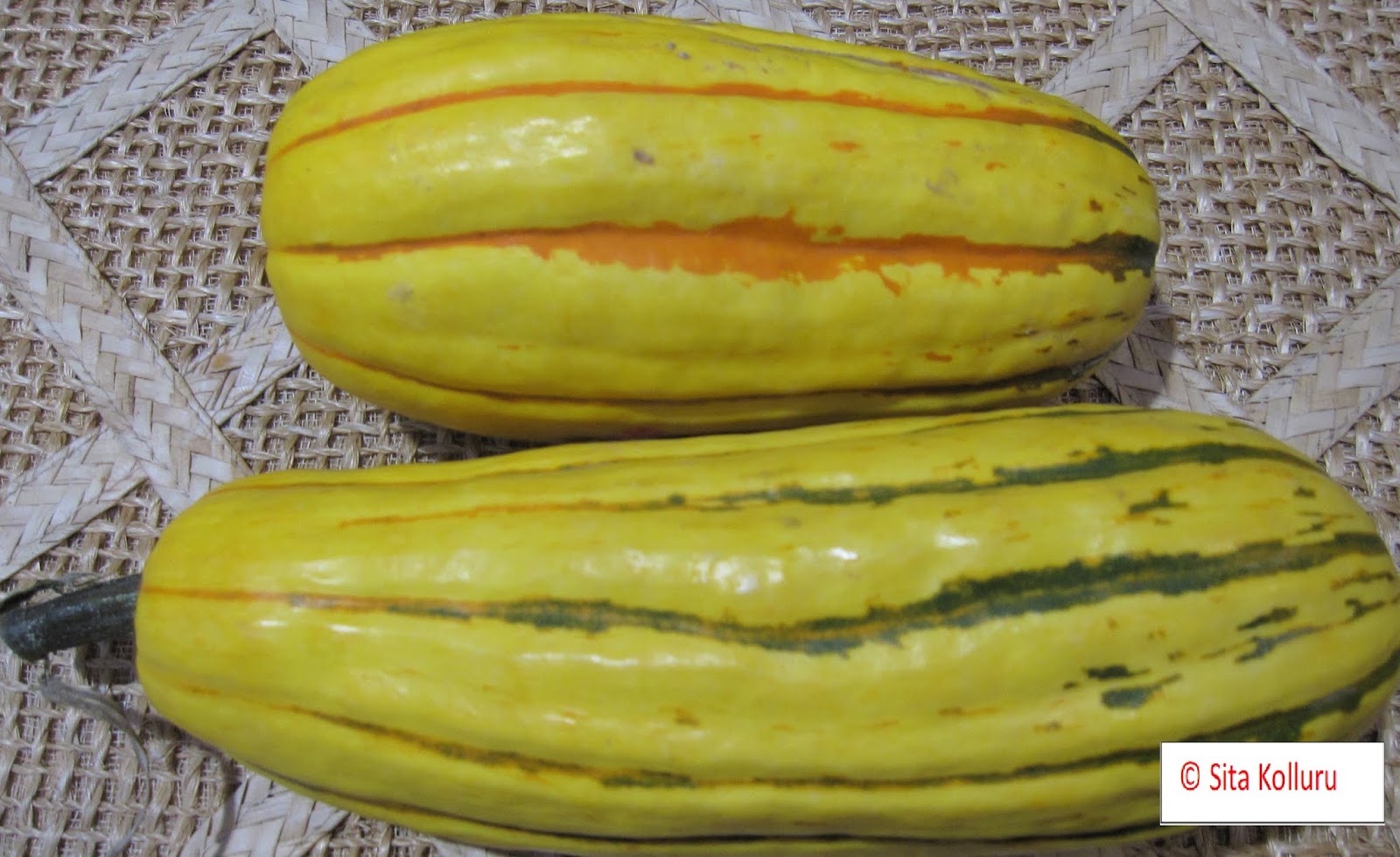
By about middle of September in USA one finds lots of pumpkins and different varieties of squash in markets. In USA a lot of varieties of winter squash, as they are called, are available. One such variety is Delicata squash. The fruit is cream colored cylindrical striped in green or orange. It has a delicate rind. It is very easy to cook and the skin is soft so need not be peeled.

Not only is delicata squash pretty to look at, but it is also nutritious. It is a good source of potassium and dietary fiber, and contains magnesium, manganese and vitamin C and B.

Delicata can be either pan fried, or baked and also used to make soups. I tried to make a subzi with Indian flavor. I made a sweet and sour subzi with delicata squash.
Of course, it is not available in India. But in USA where it is easily available, as a seasonal vegetable, it is good for health.


Ingredients:

  •      1 delicata squash (about 6 to 8 inches long)
  •      1 onion chopped
  •      2 green chiles chopped
  •      1 inch ginger chopped
  •      2 Tbsp. tamarind paste
  •      3 to 4 Tsp. jaggery
  •      Salt to taste

Seasoning:

  •      1 or 2 red chiles
  •      1 Tsp. chana dal
  •      1/2 Tsp. urad dal
  •      1 Tsp. mustard seeds
  •      1/2 Tsp. jeera seeds
  •      Pinch of asafetida
  •      2 Tsp. oil
  •      !/2 Tsp. turmeric powder
  •      Few curry leaves
  •      Cilantro to garnish

Directions:

  1.      Wash and cut the delicata squash in half.
  2.      Scoop out the seeds.
  3.      Skin of delicata is not tough.
  4.      It cooks faster and is tender after cooking and tasty.
  5.      Cut the half portions in to parallel strips.
  6.      Cut the pieces as small/big as you like.
  7.      Peel and chop onion.
  8.      Wash, peel and cut ginger.
  9.      Wash and chop green chiles.
  10.      Heat a thick bottomed pan.
  11.      Add oil.
  12.      When the oil is hot, add red chile.
  13.      After a minute, add chana and urad dal.
  14.      Keep stirring.
  15.      When the dals get slightly brown, add mustard and jeera seeds.
  16.      When the mustard seeds splutter, add hing and curry leaves.
  17.      Add chopped onions.
  18.      Cook till onions get translucent.
  19.      Add delicata pieces, and stir.
  20.      Add turmeric, chile powder and salt.
  21.      Add tamarind paste.
  22.      Add jaggery.
  23.      Stir well so that all the ingredients are coated with the masalas.
  24.      Add about 1 cup of water.
  25.      Let it come to boil
  26.      Reduce the heat and let the mixture cook till the pieces are soft to touch.
  27.      Remove from stove.
  28.      Transfer to a serving dish and garnish with cilantro.
  29.      Can be served with rice or roti.

Note:  Tamarind is available in many Indian stores across USA. One can buy either unprocesed tamarind in bags or tamarind pulp in small containers or tamarind powder. Either of these can be used. If using unprocessed tamarind, it has to be soaked in a small amount of water and microwaved for 30 or 40 seconds. Then by squeezing, the juice can be extracted and the pulp and seeds, if any, can be discarded.


Tuesday, 17 September 2019

Kamal kakadi rasedar subzi ( Lotus root/stem wet subzi)

Kamal kakadi/lotus stem/lotus root is the root of the lotus plant. The rhizomes of lotus are consumed as a vegetable in many Asian countries, extensively in China and Japan. They have a crunchy texture with sweet tangy flavors. In North India they are easily available. In South India, lotus atem is not a common vegetable. I notice that it is sometimes available in online stores. In USA many Asian markets sell them in cut pieces fresh, frozen or canned.

Kamal kakadi or lotus stem/root is extensively used in North Indian cuisine. They are fried or cooked in subzis, soups, salad or pickled in vinegar (with sugar, chile and garlic). Subzi made with kamal kakadi as the main ingredient and including eggplant, potato and palak (spinach) is highly significant in Sindhi weddings and is a part of pre wedding meal!

Kamal kakadi is packed with an array of nutrients that promote health. It is rich in dietary fiber, potassium, iron and vitamin B and C. Considering they have these important nutrients and minerals, lotus stem/root can be called as one of the healthiest foods!

Lotus stems/roots boost digestion and reduce constipation problems.

The presence of potassium and iron prevent excessive sodium and increase blood circulation and also increase production of urine, which prevents excess water retention.

Lotus stems have vitamin B complex, which interacts with neural receptors in the brain which reduces stress.

Kamal kakadi is good for skin and hair and promotes weight loss as this vegetable not only has lesser calories but packed with fiber which keeps one full for a longer period.

Maybe because of all these benefits, lotus roots have been used in Traditional Chinese Medicine to treat a variety of ailments.

As lotus stems or kamal kakadi are harvested from under water, they need a thorough cleaning before cooking. Sometimes after cutting the stems in to 6 or 8 inch tubes, you may have to use ear buds to clean the holes inside the tube!

This time, I tried making a gravy subzi with kamal kakadi. It turned out very tasty.


Ingredients:

  •      2 or 3 kamal kakadi (lotus root)
  •      3 medium tomatoes
  •      2 or 3 green cardamom
  •      1 black cardamom
  •      2 or 3 cloves
  •      1 inch cinnamon stick
  •      2 medium onions chopped
  •      3 or 4 garlic pods
  •      1/2 inch ginger
  •      1/2 Tsp. turmeric powder
  •      1 Tbsp. dhania powder (coriander powder)
  •      1/4 Tsp. jeera powder (cumin powder)
  •      1 or 2 Tsp. chile powder
  •      1/2 Tsp. garam masala
  •      Salt to taste
  •      2 Tsp. oil
  •      Cilantro for garnish

Directions:

  1.      Soak the lotus roots in water for fifteen/twenty minutes.
  2.      Scrub the outer surface and clean thoroughly.
  3.      Repeat washing and cleaning till the stems look clean.
  4.      Peel the outer skin of the kakadi.
  5.      Cut the stems in diagonal slices.
  6.      Cook the slices in pressure cooker for one or two whistles.
  7.      Peel and chop onions and garlic.
  8.      Chop tomatoes.
  9.      Grind onion, garlic and ginger in a grinder.
  10.      Grind tomatoes coarsely.
  11.      Open the cooker when the pressure is normal, drain off the water and save the slices.
  12.      Heat a deep thick pan, add oil. When the oil is hot, add the cardamom, cloves and cinnamon stick.
  13.      Cook for a minute or two.
  14.      Add onion paste. 
  15.      Keep stirring and cook till onion paste is very well cooked.
  16.      Add tomato paste. 
  17.      Cook for 6 to 8 minutes till most of the juice is evaporated.
  18.      Add the dry ingredients except garam masala and salt.
  19.      Add cooked kakadi slices. 
  20.      Let the mixture cook till the slices are well cooked.
  21.      Add garam masala and salt. Let it cook for 2 minutes.
  22.     Transfer to a serving dish and garnish with cilantro.


Wednesday, 11 September 2019

Chukkakura, pesarapappu and lauki subzi (Khatta palak, moong dal lauki subzi)


Chukkakura or khatta palak is a green vegetable available year round in many parts of India. The leaves are medium to large in size and broad and arrow shaped. Chukka leaves look similar to spinach or palak. They have a tart taste reminding of citrus. The younger leaves are less acidic.

In USA the equivalent to this plant is green sorrel. Many Indians use green sorrel in their cooking in place of chukkakura.

Chukkakura plant is grown solely for its leaves. It has been used since ancient times both medicinally to aid digestion and for culinary purposes. Chukka leaves are high in vitamin C, calcium, magnesium and potassium.

Because the leaves are tart, the leaves are used many nonvegetarian dishes also.

In Andhra Pradesh many dishes like dals and subzis are made using chukkakura. Here is a recipe with sorakaya, moong dal and chukkakura. All the ingredients that are essential for daily meals.


Ingredients:

  •      2 cups chukkakura chopped
  •      1 cup sorakaya/lauki/bottle gourd pieces
  •      1/2 cup moong dal
  •      1/2 cup grated coconut (optional)
Seasoning:
  •      2 Tsp. oil
  •      1 or 2 red chile
  •      1 Tsp. urad dal
  •      1/2 Tsp. mustard seeds
  •      1/2 Tsp. jeera seeds
  •      Pinch of hing (asafetida)
  •      Few curry leaves
  •      Salt to taste
Directions:
  1.      Soak moong dal for about 2 hours.
  2.      Wash and clean chukkakura.
  3.      Chop the vegetable in to pieces.
  4.      Wash and peel sorakaya.
  5.      Cut into small pieces.
  6.      Heat oil in a thick pan.
  7.      Add red chile, and urad dal.
  8.      Cook for a minute.
  9.      Add mustard and jeera seeds.
  10.      When mustard seeds are spluttering add hing and curry leaves.
  11.      Add lauki pieces.
  12.      Cook for a few minutes.
  13.      Wash and drain moong dal.
  14.      Add drained dal to the ingredients in the pan.
  15.      Mix well.
  16.      After a few minutes, add chopped chukkakura.
  17.      Add salt and mix well.
  18.      Add grated coconut (optional).
  19.      Cover and cook on low heat.
  20.      Keep mixing so that the subzi is not burnt.
  21.      When the dal and lauki pieces are soft, stop cooking.
  22.      The subzi must not be overcooked and mushy.
  23.      Keep covered and let it cool a bit.
  24.      Transfer to a serving dish.
  25.      Garnish with cilantro and fresh grated coconut.
  26.      A healthy and tasty side dish for roti and rice.


Tuesday, 6 August 2019

Chinta chiguru podi (Tender tamarind leaves powder)


Chinta chiguru, tender tamarind leaves is available in South India during early spring. As the name suggests, tender leaves from tamarind tree are sold in Andhra Pradesh and other South Indian states. The leaves have a subtle tart flavor without being overly sour. They increase the nutrient value of the dish and add a nice tangy taste to it. Quite a few dishes are made with the leaves like dal and pulao etc.

The leaves are a good source of vitamin C. As any seasonal vegetable, use of the leaves is recommended by nutritionists.

I found some bottled leaves in the Indian stores in USA. If you look around, you may find the leaves in some Asian stores.

In this recipe I am drying the leaves and making the powder. So the powder may be stored for longer periods. In some areas, this powder is called chintaku podi. For this recipe, you do not need very tender leaves. As the leaves are being dried and roasted, even older and slightly tough leaves can be used.


Ingredients:


  •      2 cups chinta chiguru (Tamarind leaves)
  •      2 Tbsp. chana dal
  •      2 Tbsp. urad dal
  •      3 Tbsp. til seeds (Sesame seeds)
  •      3 or 4 red chiles
  •      1/2 Tsp. hing (Asafetida)
  •      1 Tsp. or less oil
  •      Salt to taste


Directions:

  1.      Wash and remove any hard stems.
  2.      Spread the leaves on a dry cloth and dry in shade.
  3.      Leave them to dry completely.
  4.      Heat a thick pan and add oil.
  5.      Add red chiles and let them fry for a minute.
  6.      Add chana dal and keep stirring.
  7.      Add urad dal.
  8.      When the dals are turning light brown, add til seeds.
  9.      Keep stirring.
  10.      Remove from heat.
  11.      Transfer the mixture to a bowl.
  12.      Let cool.
  13.      Heat the pan again and add dried chinta chiguru.
  14.      Keep stirring for a minute or two.
  15.      Remove from heat.
  16.      Transfer to another bowl.
  17.      In a grinder, process the dal mixture.
  18.      Add the roasted leaves and salt.
  19.      Grind to a coarse mixture.
  20.      Store in a dry jar.
  21.      Tastes very nice.
  22.      Can be eaten with rice, idli or dosa etc.