Showing posts with label fusion cooking. Show all posts

Thursday, 31 October 2019

Gummadikaya (Delicata squash) subzi (Delicata subzi with Indian flavor)

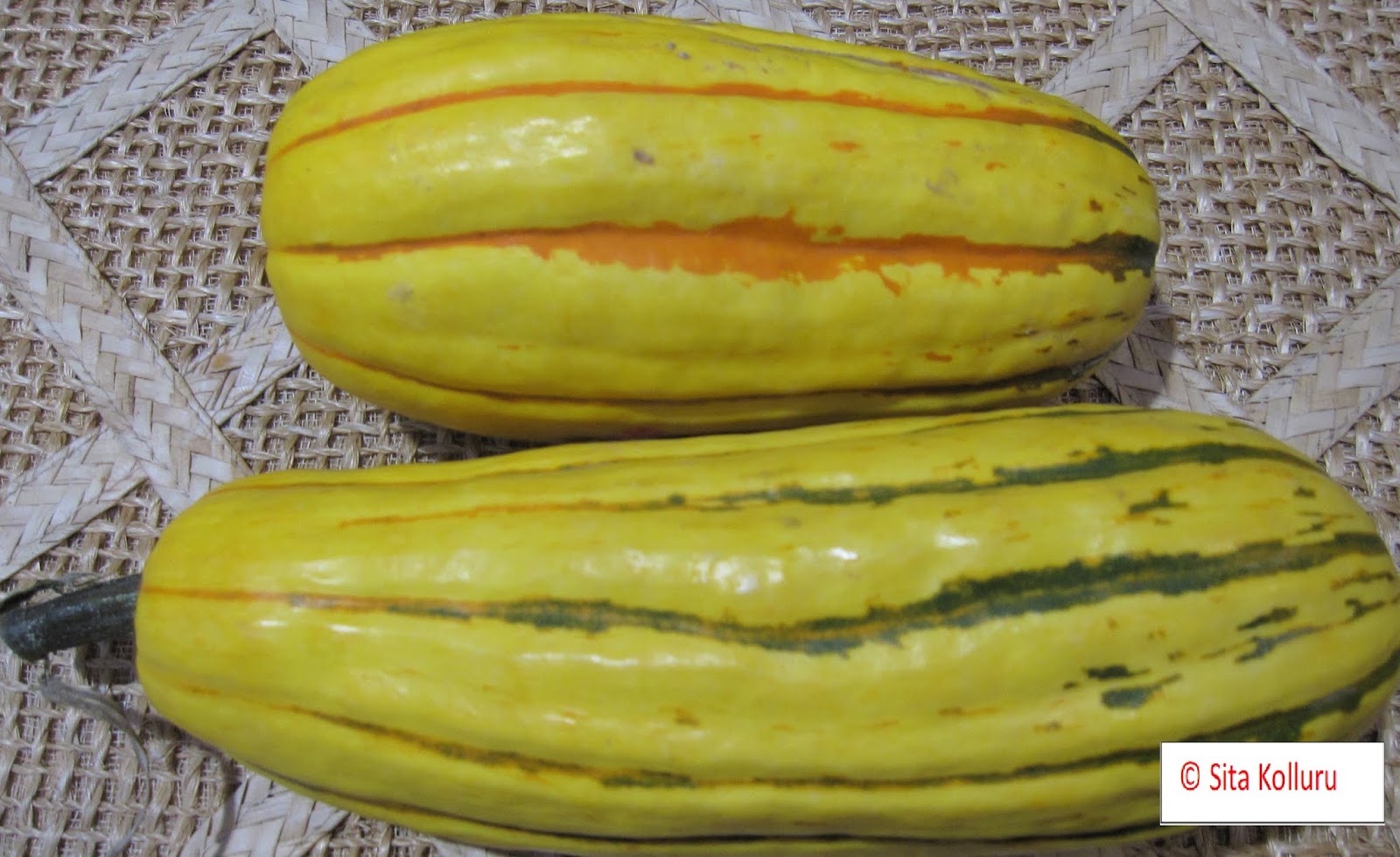
By about middle of September in USA one finds lots of pumpkins and different varieties of squash in markets. In USA a lot of varieties of winter squash, as they are called, are available. One such variety is Delicata squash. The fruit is cream colored cylindrical striped in green or orange. It has a delicate rind. It is very easy to cook and the skin is soft so need not be peeled.

Not only is delicata squash pretty to look at, but it is also nutritious. It is a good source of potassium and dietary fiber, and contains magnesium, manganese and vitamin C and B.

Delicata can be either pan fried, or baked and also used to make soups. I tried to make a subzi with Indian flavor. I made a sweet and sour subzi with delicata squash.
Of course, it is not available in India. But in USA where it is easily available, as a seasonal vegetable, it is good for health.


Ingredients:

  •      1 delicata squash (about 6 to 8 inches long)
  •      1 onion chopped
  •      2 green chiles chopped
  •      1 inch ginger chopped
  •      2 Tbsp. tamarind paste
  •      3 to 4 Tsp. jaggery
  •      Salt to taste

Seasoning:

  •      1 or 2 red chiles
  •      1 Tsp. chana dal
  •      1/2 Tsp. urad dal
  •      1 Tsp. mustard seeds
  •      1/2 Tsp. jeera seeds
  •      Pinch of asafetida
  •      2 Tsp. oil
  •      !/2 Tsp. turmeric powder
  •      Few curry leaves
  •      Cilantro to garnish

Directions:

  1.      Wash and cut the delicata squash in half.
  2.      Scoop out the seeds.
  3.      Skin of delicata is not tough.
  4.      It cooks faster and is tender after cooking and tasty.
  5.      Cut the half portions in to parallel strips.
  6.      Cut the pieces as small/big as you like.
  7.      Peel and chop onion.
  8.      Wash, peel and cut ginger.
  9.      Wash and chop green chiles.
  10.      Heat a thick bottomed pan.
  11.      Add oil.
  12.      When the oil is hot, add red chile.
  13.      After a minute, add chana and urad dal.
  14.      Keep stirring.
  15.      When the dals get slightly brown, add mustard and jeera seeds.
  16.      When the mustard seeds splutter, add hing and curry leaves.
  17.      Add chopped onions.
  18.      Cook till onions get translucent.
  19.      Add delicata pieces, and stir.
  20.      Add turmeric, chile powder and salt.
  21.      Add tamarind paste.
  22.      Add jaggery.
  23.      Stir well so that all the ingredients are coated with the masalas.
  24.      Add about 1 cup of water.
  25.      Let it come to boil
  26.      Reduce the heat and let the mixture cook till the pieces are soft to touch.
  27.      Remove from stove.
  28.      Transfer to a serving dish and garnish with cilantro.
  29.      Can be served with rice or roti.

Note:  Tamarind is available in many Indian stores across USA. One can buy either unprocesed tamarind in bags or tamarind pulp in small containers or tamarind powder. Either of these can be used. If using unprocessed tamarind, it has to be soaked in a small amount of water and microwaved for 30 or 40 seconds. Then by squeezing, the juice can be extracted and the pulp and seeds, if any, can be discarded.


Tuesday, 25 October 2016

Cranberry sweet and sour chutney


Cranberries are acidic to taste and taste very much like vakkay in Telugu or karonda in Hindi.

Fresh cranberries can be frozen at home and will keep up to 9 months.

In some metropolitan cities in India, cranberries are available.

Cranberries can be called wonder fruit as they have many nutritional benefits. They help in preventing urinary tract infections. They are well known for anti-inflammatory benefits, cardiovascular benefits, anti-cancer benefits and antioxidant protection etc.

Cranberry sauce or relish are commonly associated with traditional Thanksgiving dinner.

Cranberries are usually processed into products such as juice, jam, sauce etc or sweetened dried.  We can make some popular Indian dishes like chutneys or pickles etc I have tried sweet and sour chutney. If you prefer, you may fry some garlic pods in oil and use them as topping. It reminds one of popular Andhra tamarind sweet and sour chutney!

Now, fresh cranberries are available in stores.


Ingredients:

  •      1 cup cranberries
  •      1 Tsp. methi mustard powder
  •      2 Tsp. chile powder
  •      3 to 4 Tsp. jaggery
  •      Salt to taste
  •      3 to 4 Tsp. oil
  •      A few garlic pods (peeled)

Directions:

  1.      Wash and dry cranberries on a cloth.
  2.      Heat a thick pan and add oil.
  3.      When the oil is hot, add cranberries.
  4.      Keep stirring till the cranberries pop.
  5.      When all the berries popped up, remove from heat.
  6.      Add chile powder, methi mustard powder, jaggery, and salt.
  7.      Mix well and let the mixture stay in hot pan.
  8.      If preferred, you can process the chutney in a grinder or just mash it with ladle
  9.      If using garlic, fry the garlic in hot oil and add it to the chutney.
  10.      Transfer the chutney to a bottle.
  11.      The sweet and sour taste and the flavor are unique.


Sunday, 18 September 2016

Sandita sweet and sour chutney(Mexican sour gherkin sweet and sour chutney)

In my experiments with sandita I tried making sweet and sour chutney. In fact, you may try this recipe with dondakaya also. If dondakaya is slightly ripe also, it can be used. If you do not have sandita, go ahead and try with dondakaya.


Ingredients:

  •      2 cups sandita (cut into pieces)
  •      1 Tsp. mustard methi powder
  •      Small ball (about an inch diameter) of tamarind or
  •      1 Tbsp. tamarind paste
  •      1/4 Tsp. turmeric powder
  •      2 green chiles (according to taste)
  •      2 Tsp. jaggery (optional)
  •      1 or 2 Tsp. chile powder (optional)
  •      Salt to taste
  •      2 Tsp. oil

Directions:

  1.      Clean and cut sandita into discs or small pieces.
  2.      Heat oil in a thick pan.
  3.      Add sandita pieces and cook for 5 to 10 minutes.
  4.      Keep stirring.
  5.      Add green chiles also and cook for 2 or 3 minutes.
  6.      Remove from heat.
  7.      Add tamarind, let it cool.
  8.      Add turmeric, methi mustard powder, jaggery, and salt.
  9.      Transfer all these to a grinder jar and process.
  10.      Add 2 or 3 spoons of water, if needed.
  11.      Tastes nice if the chutney is slightly crunchy and not too soft.
  12.      Sandita chutney is a good side dish for rice, rotis, idli dosa etc.


Tuesday, 6 September 2016

Brussels sprouts with grated coconut subzi

Brussels sprouts is a cool season crop and very popular in Europe and USA. This vegetable was originally grown in Belgium and possibly that is why the name Brussels sprouts! Brussels sprouts resemble miniature cabbages. Unlike cabbage, they grow in bunches of 20 to 40 on the stem of a plant.

Brussels sprouts are low glycemic and nutritious vegetables. They are excellent sources of many vitamins like A, B complex and vitamin K which helps in preventing Alzheimer's disease. Lots of minerals like copper, calcium, potassium, iron, manganese and phosphorous are also available in the sprouts.

Thus, brussels sprouts are incredibly nutritious vegetables and they offer protection from many deficiencies and believed to protect from heart diseases and colon and prostate cancer.

In India, they are not seen in markets, but, in places like Delhi, you can buy them in super markets.
I tried making the subzi using what is available in Delhi, but, as the sprouts are not fresh and they also were not tender, the taste was not at all like the one I made with fresh sprouts in USA. I understand that in big metros, the sprouts are available in the market. So, unless you get really fresh ones in local markets, you do not try this subzi.


Ingredients:

  •      2 cups brussels sprouts, cut into halves or quarters
  •      3 to 4 Tbsp. grated coconut (fresh or dehydrated)
  •      1 red chile
  •      1 Tsp. chana dal
  •      1 Tsp. urad dal
  •      1/2 Tsp. mustard seeds
  •      1/2 Tsp. jeera seeds
  •      A few curry leaves
  •      2 Tsp. oil
  •      Salt to taste

Directions:

  1.      Wash and cut brussels sprouts into halves or quarters according to taste.
  2.      If the outside leaves are very tough, you may discard them. Otherwise, you may cook along with the outside leaves also.
  3.      Heat the pan and add oil.
  4.      When the oil is hot, add red chile.
  5.      After a minute add chana dal, urad dal, mustard seeds and jeera seeds.
  6.      When mustard seeds splutter, add curry leaves.
  7.      Add brussels sprouts and keep stirring.
  8.      Add a few spoons of water, (if necessary), cover and cook for 3 to 4 minutes.
  9.      Keep stirring in between.
  10.      Add grated coconut and let it cook for a few more minutes.
  11.      Keep stirring so that the vegetable is not burnt.
  12.      Turn off the heat.
  13.      Serve hot. Very tasty dish and can be served with rice or roti.
 

Wednesday, 17 August 2016

Mexican sour gherkins subzi

Mexican sour gherkin are also known as mouse melon or melothria scabra. They are the size of large grapes, look like our kundru (miniature) or doll sized watermelons and taste like cucumber or kundru. This variety is not  genetically-modified hybrid developed in laboratories! It is heirloom that has been grown and eaten in Mexico for centuries. A long-lost heirloom, cucamelon has only recently been rediscovered. Now, they are grown in USA and are available in farmer's markets etc during summer. Mexican sour gherkin is mostly used in salads, pickles along with pearl onions etc.
If you are looking for seeds to plant in your garden, you may have to look for "melothria scabra"

  
Google search provided some information about its availability in India, though I wonder if it is the same vegetable. Kachri or kachari is a wild variety of cucumbers, and grows wildly in Rajasthani desert. It is supposed to be sour to taste and kachri powder is used in tenderizing meats etc.

Last year it was planted in our yard and the fruits were eaten raw from the plant as snack! It almost looks like kundru and also tastes very much like kundru or cucumber. I wanted to make use of this vegetable in making Indian subzi. This year we got quite a few of cucamelons and I got to experiment. You may use the same masala as in the recipe for dondakaya kothinira karam kura also. I am inserting some photos of the climber etc for more information.

Here is one recipe:


Mexican sour gherkin on the climber:


 Ready for cutting:                                                                           Cut only partially:


As compared to kundru you can see the size:


After microwaving and in the pan:


After adding besan and masalas:


Ready to be transferred:


Ingredients:

  •      2 cups sour gherkin
  •      2 to 3 tsp. oil
  •      3 tbsp. besan (chickpea flour)
  •      1 tsp. chili powder
  •      1/4 tsp. jeera powder.
  •      Salt to taste
  •      1 tsp. jeera seeds (cumin)

Directions:

  1.      Place sour gherkin in a microwave safe bowl.
  2.      Sprinkle a little water.
  3.      Cook covered in a microwave for 1 or 2 minutes.
  4.      Melons must be parboiled and not mushy.
  5.      Heat oil in a nonstick pan.
  6.      Add jeera and stir for a minute.
  7.      Add microwaved melons and keep stirring for a few minutes.
  8.      Mix besan, salt, chili powder and jeera powder in a plate.
  9.      Sprinkle the powder mixture to the melons.
  10.      Keep cooking on medium heat and keep stirring.
  11.      When besan gets golden brown in color, stop cooking.
  12.      Transfer to a bowl and serve.
  13.      A good side dish for rice, roti etc.
     

Friday, 8 July 2016

Green apple pacchadi (Green apple chutney South Indian style)

Apple is the most popular fruit, which may be the reason for the popular saying "an apple a day, keeps the doctor away"!

Apples are high in fiber, and many antioxidants. They are very filling. They are high in carbohydrate and sugar content, but they have a very low glycemic index. They are rich in vitamin C and potassium which are very beneficial for health.

Health benefits of apples are numerous like, antioxidant benefits, cardiovascular benefits for blood sugar control, anti-cancer benefits and anti-asthma.

A variety of recipes can be tried with raw apples. Chutney is a kind of relish or dip which can be used with rice, roti or sandwiches.

In USA, many green apples which are still not ripe are available in abundance. In India, Granny Smith apples, which are available in super markets or some locally grown apples are good for this recipe. I did not peel the apples as the fiber is good and adds to the crunchy feeling. The chutney tastes almost like coconut chutney with a tinge of sweetness.


Ingredients:

  •      2 cups chopped green apples
  •      2 or 3 green chiles
  •      2 Tsp. mustard methi powder
  •      1/2 Tsp. turmeric powder
  •      Pinch hing
  •      2 Tsp. lemon juice

Directions:

  1.      Wash and cut apples. Need not peel.
  2.      Remove the core.
  3.      Cut them into cubes.
  4.      Process the ingredients in a vegetable chopper or blender.
  5.      Add lemon juice, mix well and serve.
  6.      Tastes good with rice, roti, dosa etc.


Wednesday, 30 March 2016

Brussels sprouts subzi (with Indian flavor)


Brussels sprouts is a cool season crop and very popular in Europe and USA. This vegetable was originally grown in Belgium and possibly that is why the name Brussels sprouts! Brussels sprouts resemble miniature cabbages. Unlike cabbage, they grow in bunches of 20 to 40 on the stem of a plant.

Brussels sprouts are low glycemic and nutritious vegetables. They are excellent source s of many vitamins like A, B complex and vitamin K which helps in preventing Alzheimer's disease. Lots of minerals like copper, calcium, potassium, iron, manganese and phosphorous are also available in the sprouts.

Thus, brussels sprouts are incredibly nutritious vegetables and they offer protection from many deficiencies and believed to protect from heart diseases and colon and prostate cancer.

In India, they are not seen in markets, but, in places like Delhi, you can buy them in super markets.
I tried making the subzi using what is available in Delhi, but, as the sprouts are not fresh and they also they were not tender, the taste was not at all like the one I made with fresh sprouts in USA.  So, unless you get really fresh ones in local markets, you do not try this subzi.

Here is a recipe using the brussels sprouts with Indian masalas.


Ingredients:

  •      2 cups of brussels sprouts (quartered)
  •      1 Tsp. chana dal
  •      1 Tsp. urad dal
  •      1/2 Tsp. mustard seeds
  •      A pinch of hing (asafetida)
  •      A few curry leaves
  •      2 Tbsp. onion, finely chopped
  •      1 tomato, finely chopped
  •      1 or 2 green chilis, finely chopped
  •      1 Tbsp. tamarind paste
  •      2 Tsp. sambar powder
  •      1 Tsp. red chii powder
  •      Salt to taste
  •      1 Tsp. jiggery
  •      1 Tbsp. oil

Directions:

  1.      Wash and quarter the brussels sprouts.
  2.      Heat oil in a deep thick pan.
  3.      Add chana dal, and let it cook for 2 or 3 minutes.
  4.      Add urad dal, and when the dal is turning golden, add mustard seeds.
  5.      When mustard seeds start spluttering, add hing and curry leaves.
  6.      After cooking for a minute, add green chili pieces and onion pieces.
  7.      Stir well for 2 to 3 minutes, till onion pieces are translucent.
  8.      Add tomato pieces.
  9.      Add turmeric powder, sambar powder, salt.
  10.      Mix well. Add tamarind paste and cook for 2 minutes.
  11.      Add jaggery.
  12.      Add brussels sprouts and half cup water.
  13.      Mix well and let it cook till brussels sprouts are cooked.
  14.      Sprinkle a little water, if the subzi is looking dry.
  15.      Serve it hot.
  16.      Goes well with roti and rice.


Friday, 18 March 2016

Ravioli (homemade, using different ingredients)

 
Ravioli is basically an Italian dish which is very popular all over the world. Ravioli are a type of dumpling composed of a filling sealed between two layers of thin pasta dough. They are usually served with a pasta sauce on the side or served in a soup bowl filled with sauce and ravioli dipped in it.

Different ingredients are used as filling and for sauce. Most common ingredients are spinach, ricotta cheese and squash. Some new flavors and tastes are also experimented. For example, I came across spinach cheese ravioli with pumpkin sauce (Times of India) and Jackfruit ravioli with chilli cardamom emulsion (Deccan Chronicle)!

I requested Doreen Gillespie to contribute this recipe. It is a real fusion of ingredients, flavors and tastes!! She has done a great job making the ravioli, photographed all the  details and documented the whole stuff!

Doreen's recipe follows in her own words! Try it and enjoy!!


When I make pasta, I enjoy experimenting with different flours, seasoning, and vegetables in the  pasta dough both for nutrition and for flavor, so I rarely make it the same way twice. I encourage you to experiment, too! Many people make pasta with a basic white flour (maida), eggs and salt. But I always use a base of semolina flour, made from durum wheat. Instead of 100% semolina, however, I use 50% semolina and make up the balance with various other flours. I suggest that at least some of the other flours contain gluten (wheat, oat, barley etc.). I have also experimented with acorn flour, chickpea flour (besan), and millet flour. In the US grocery stores carry Bob's Red Mill products, so they should have the semolina. The semolina found in India is likely not from durum wheat, so it may not yield as firm pasta as ideal, but feel free to try  it.

I use eggs in my pasta, but you can substitute water for the eggs. The texture will be different, and the dough will be a little more fragile than I prefer for ravioli, but the pasta will still be tasty!

For this pasta, I blended fresh kale into the eggs for a very fine puree. The kale makes the pasta a brilliant green and also adds nutrition and flavor. Spinach, mustard greens, collard greens, chard, or other greens could be used similarly. If you use mustard greens, expect that they may impart a stronger flavor than the other greens.

I have made ravioli with many different fillings, and I have recently been experimenting with using ajwain leaves. Ajwain (Trachyspermum ammi) is grown easily in the USA, though I have not gotten it to flower and produce the more commonly used seeds in Western Washington State. I grow it outside from April through October, then bring plants inside for the winter. The plants can be started from cuttings extremely easily. Ajwain is also known as Indian oregano, Cuban oregano and Spanish oregano. The variety common in India (and grown in the US) has large succulent leaves that can grow to up to 2 - 3 inches. A small-leaved variety is also available in the US, frequently known by the same names and sharing a similar flavor. Ajwain can be grown outside when temperatures are above 45 degrees F and grown indoors year-round. When grown outside, it does best when not grown in full sun.

For this recipe, I based my filling on a recipe for thuvaiyal from this following site.
http://www.tastyappetite.net/2011/11/karpooravalli-ajwain-leaves-thuvaiyal.html?m=1
You can use the basic thuvaiyal as the filling, but I added winter squash and paneer for a richer flavor.

Pasta dough:

Ingredients:
  •      1 cup semolina flour (durum)
  •      1/2 cup atta
  •      1/2 cup millet flour
  •      2 eggs (or about 3/8cup water)
  •      8 large lacinato kale leaves, stripped off the stalks (palak or any greens)
  •      1tsp. salt
  •      1 tsp ground cumin (jeera)

Directions:

  1.      Mix the flours, salt and cumin powder.
  2.      In a blender, puree kale into eggs (or water), see the picture below.
  3.      Mix liquid puree into the dry mixture, using hands to thoroughly mix into a dough.
  4.      If necessary, add only enough additional water to fully moisten all the flour. Knead the   dough to fully mix, but it may not be smooth. The dough should be stiff. If it is too moist, it will be difficult to roll through a pasta machine, but slightly more moisture is needed if rolling out with a rolling pin. 
  5.      Wrap dough in plastic or place in a covered dish and set aside (refrigerator or room temperature) for at least one hour. This will ensure even moisture distribution and result in a smoother dough.


Filling:

Make thuvaiyal recipe below (modified from original recipe on website mentioned above.)

Ingredients:
  •      15 large (2 inch wide or larger ajwain leaves. (about 100gm total)
  •      2 tsp. oil
  •      1/4 cup urad dal
  •      1Tbsp. coriander seeds (sabud dhaniya)
  •      3/4 tsp cumin (jeera seeds)
  •      1 dry red chili
  •      1 Tbsp grated ginger
  •      2 medium garlic cloves
  •      2 Tbsp turmeric powder
  •      2 Tbsp jiggery
  •      1/4 tsp methi-mustard powder
  •      Salt to taste
  •      3/4 cup peeled and cubed winter squash (sugar pumpkin, butternut, kabocha etc.)
  •      1/2 cup paneer (about 100gm)
Directions:
  1.      Wash the fresh ajwain leaves
  2.      Heat oil in a fry pan.
  3.      Roast urad dal to golden color, set aside.
  4.      Add ajwain leaves to the hot pan and sauté for about three minutes; set aside. The leaves will not completely wilt or look cooked.
  5.     Add coriander seeds, cumin, red chili and garlic to the hot pan. 
  6.     Roast until seeds start to change color, then add ginger, tamarind paste and jiggery.
  7.     Stir and cook for about one minute; allow to cool.
  8.     In a blender, finely blend all cooked ingredients to a smooth mixture.
  9.     Add methi-mustard powder, hing and salt to taste.
  10.     Steam or roast squash until tender.
  11.    Blend paneer and squash with ajwain mixture until smooth.


Making Ravioli:

To make the ravioli, the pasta needs to be rolled thin. Pictured is an example of a simple pasta machine, which rolls the dough between two cylinders.


This is certainly the easiest way to roll out pasta, but rolling pins also work with more effort. I roll my dough to about 1/16 inch thick, approximately 1.5mm. For rolling out the dough, whether by machine or by a rolling pin, I cut thin slices off the chunk of dough.

If you are rolling with a rolling pin, roll out the dough into a 12 inch wide and 16 inch long piece. It can be slightly thicker than roti. Fold and roll again. Repeat the process thrice. Cut into 10 inch by 12 inch sheets.


I show two options here for making ravioli. The simplest way is to place filling onto a full sheet.


I then moisten spaces between the piles (use water) and place a top sheet over the filling. Press the top sheet on to the lower sheet, pushing tightly to seal with your hand.


Ravioli can be cut apart with a knife -- I show here a tool that seals and cuts the ravioli leaving an interesting crimping texture at the same time.


The second option uses a press that may be sold in the US, as a calzone press, empanada press or dough press. In India, a kajjikaya/gujjia press can be used similarly. The bottom edge of the press cuts the dough.


The circle of dough is then placed on top of the press, filled, then sealed by folding and closing the press. Moistening the edges with water before closing the press will make a stronger seal.

Cooking Ravioli:

To cook the ravioli, bring a pot of water to a rolling boil. With fresh pasta, it takes only about three minutes to cook, unless the pasta is much thicker than recommended above. Add the made pasta and let it cook for 3 to 4 minutes. Drain off and serve hot along with sauces.

Final dish: 

Three sauces are pictured here. At the bottom left is a commercial traditional Italian tomato sauce. At the bottom right is a commercial pumpkin pasta sauce, diluted 1:1 with drained fresh yogurt. At the top is a homemade shiso pesto diluted into 1:1 mixture of commercial alfredo sauce and drained fresh yogurt.


Friday, 16 October 2015

Cranberry pickle (South Indian style)


This happens to be my 100th post in my blog! I never thought that I can manage a food blog at all!!

In my family and among my close friends, Sita's cooking was always a big joke. I was never very interested in cooking. Maybe that is the reason to start this blog, where I try to spend very little time in the kitchen and prepare some healthy and nutritious food!

My husband Gokhale Kolluru was the first person who urged me to document the recipes so that the next generation could be benefited. I dedicate my blog to his memory. My daughter-in-law Doreen Gillespie is good at gardening and experimenting in cooking. It is her insatiable interest which makes me give her more and more recipes. All the members of my family are encouraging me in this ongoing effort.

When I started my blog, I did not even know how to post or insert pictures or link posts etc. For me, it is a continuous  learning process. A lot of youngsters were teaching me how to start a blog, how to go about these procedures. I am indebted to all of them. Of course, I thank all friends from everywhere who are following my recipes.

My sister Mrs Kamala Subbarao was an expert cook. Cooking was a passion for her. She was always experimenting with ingredients and combinations. My niece, Neelaveni Sankar has contributed this post which is her mother's recipe.

Pickle immediately after making:                                                       Pickle after 2 or 3 days:


Ingredients:

  •      2 Cups cranberry
  •      4 Tbsp. chile powder
  •      4 Tbsp. mustard seeds
  •      5 Tbsp. salt
  •      4 Tbsp. oil
  •      1/2 Tsp. turmeric powder
  •      Pinch of hing (Asafetida)

Directions:

  1.      Wash and dry cranberries.
  2.      Grind mustard seeds to make mustard powder. (If you get ready  made mustard powder, you may use that)
  3.      Heat oil in a deep pan.
  4.      Add cranberries.
  5.      Cook on low heat till cranberries pop.
  6.      Turn off heat.
  7.      Add turmeric powder, hing, salt, chile powder and mustard powder.
  8.      Mix well and let it cool.
  9.      Transfer to a dry bottle and refrigerate.