Showing posts with label Indian recipe using local vegetables. Show all posts

Thursday, 31 October 2019

Gummadikaya (Delicata squash) subzi (Delicata subzi with Indian flavor)

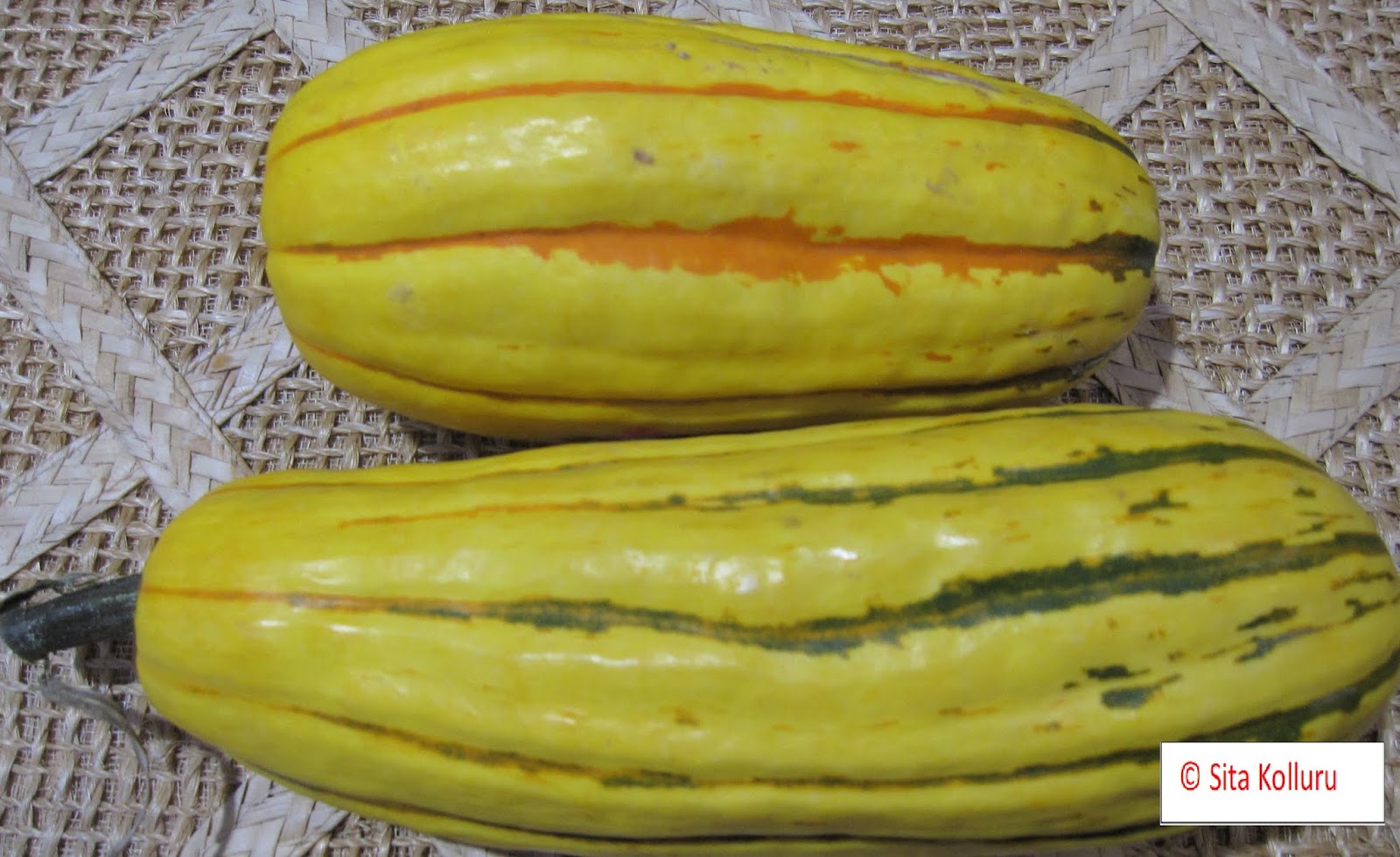
By about middle of September in USA one finds lots of pumpkins and different varieties of squash in markets. In USA a lot of varieties of winter squash, as they are called, are available. One such variety is Delicata squash. The fruit is cream colored cylindrical striped in green or orange. It has a delicate rind. It is very easy to cook and the skin is soft so need not be peeled.

Not only is delicata squash pretty to look at, but it is also nutritious. It is a good source of potassium and dietary fiber, and contains magnesium, manganese and vitamin C and B.

Delicata can be either pan fried, or baked and also used to make soups. I tried to make a subzi with Indian flavor. I made a sweet and sour subzi with delicata squash.
Of course, it is not available in India. But in USA where it is easily available, as a seasonal vegetable, it is good for health.


Ingredients:

  •      1 delicata squash (about 6 to 8 inches long)
  •      1 onion chopped
  •      2 green chiles chopped
  •      1 inch ginger chopped
  •      2 Tbsp. tamarind paste
  •      3 to 4 Tsp. jaggery
  •      Salt to taste

Seasoning:

  •      1 or 2 red chiles
  •      1 Tsp. chana dal
  •      1/2 Tsp. urad dal
  •      1 Tsp. mustard seeds
  •      1/2 Tsp. jeera seeds
  •      Pinch of asafetida
  •      2 Tsp. oil
  •      !/2 Tsp. turmeric powder
  •      Few curry leaves
  •      Cilantro to garnish

Directions:

  1.      Wash and cut the delicata squash in half.
  2.      Scoop out the seeds.
  3.      Skin of delicata is not tough.
  4.      It cooks faster and is tender after cooking and tasty.
  5.      Cut the half portions in to parallel strips.
  6.      Cut the pieces as small/big as you like.
  7.      Peel and chop onion.
  8.      Wash, peel and cut ginger.
  9.      Wash and chop green chiles.
  10.      Heat a thick bottomed pan.
  11.      Add oil.
  12.      When the oil is hot, add red chile.
  13.      After a minute, add chana and urad dal.
  14.      Keep stirring.
  15.      When the dals get slightly brown, add mustard and jeera seeds.
  16.      When the mustard seeds splutter, add hing and curry leaves.
  17.      Add chopped onions.
  18.      Cook till onions get translucent.
  19.      Add delicata pieces, and stir.
  20.      Add turmeric, chile powder and salt.
  21.      Add tamarind paste.
  22.      Add jaggery.
  23.      Stir well so that all the ingredients are coated with the masalas.
  24.      Add about 1 cup of water.
  25.      Let it come to boil
  26.      Reduce the heat and let the mixture cook till the pieces are soft to touch.
  27.      Remove from stove.
  28.      Transfer to a serving dish and garnish with cilantro.
  29.      Can be served with rice or roti.

Note:  Tamarind is available in many Indian stores across USA. One can buy either unprocesed tamarind in bags or tamarind pulp in small containers or tamarind powder. Either of these can be used. If using unprocessed tamarind, it has to be soaked in a small amount of water and microwaved for 30 or 40 seconds. Then by squeezing, the juice can be extracted and the pulp and seeds, if any, can be discarded.


Wednesday, 17 August 2016

Mexican sour gherkins subzi

Mexican sour gherkin are also known as mouse melon or melothria scabra. They are the size of large grapes, look like our kundru (miniature) or doll sized watermelons and taste like cucumber or kundru. This variety is not  genetically-modified hybrid developed in laboratories! It is heirloom that has been grown and eaten in Mexico for centuries. A long-lost heirloom, cucamelon has only recently been rediscovered. Now, they are grown in USA and are available in farmer's markets etc during summer. Mexican sour gherkin is mostly used in salads, pickles along with pearl onions etc.
If you are looking for seeds to plant in your garden, you may have to look for "melothria scabra"

  
Google search provided some information about its availability in India, though I wonder if it is the same vegetable. Kachri or kachari is a wild variety of cucumbers, and grows wildly in Rajasthani desert. It is supposed to be sour to taste and kachri powder is used in tenderizing meats etc.

Last year it was planted in our yard and the fruits were eaten raw from the plant as snack! It almost looks like kundru and also tastes very much like kundru or cucumber. I wanted to make use of this vegetable in making Indian subzi. This year we got quite a few of cucamelons and I got to experiment. You may use the same masala as in the recipe for dondakaya kothinira karam kura also. I am inserting some photos of the climber etc for more information.

Here is one recipe:


Mexican sour gherkin on the climber:


 Ready for cutting:                                                                           Cut only partially:


As compared to kundru you can see the size:


After microwaving and in the pan:


After adding besan and masalas:


Ready to be transferred:


Ingredients:

  •      2 cups sour gherkin
  •      2 to 3 tsp. oil
  •      3 tbsp. besan (chickpea flour)
  •      1 tsp. chili powder
  •      1/4 tsp. jeera powder.
  •      Salt to taste
  •      1 tsp. jeera seeds (cumin)

Directions:

  1.      Place sour gherkin in a microwave safe bowl.
  2.      Sprinkle a little water.
  3.      Cook covered in a microwave for 1 or 2 minutes.
  4.      Melons must be parboiled and not mushy.
  5.      Heat oil in a nonstick pan.
  6.      Add jeera and stir for a minute.
  7.      Add microwaved melons and keep stirring for a few minutes.
  8.      Mix besan, salt, chili powder and jeera powder in a plate.
  9.      Sprinkle the powder mixture to the melons.
  10.      Keep cooking on medium heat and keep stirring.
  11.      When besan gets golden brown in color, stop cooking.
  12.      Transfer to a bowl and serve.
  13.      A good side dish for rice, roti etc.
     

Thursday, 17 September 2015

Sandita kothimira karam kura (sandita cooked with cilantro)

In my experiments to cook different dishes with sandita, I tried my favorite masala, cilantro. As you might have noticed, I use this masala for a variety of vegetables, like dondakaya/ parval/ eggplant etc. It comes in handy, to grind cilantro with green chile and keep the paste in refrigerator and use it during the week.


Ingredients:

  •      2 cups sandita
  •      1 cup cut cilantro
  •      1 or 2 green chiles
  •      Salt to taste
  •      3 to 4 Tsp. oil

Directions:

  1.      Clean cilantro, grind to a paste adding green chiles
  2.      Either cut sandita in half or just make a slit half way through.
  3.      Microwave for 3 minutes on medium heat.
  4.      Add oil to a thick pan, add sandita.
  5.      Stir sandita and add cilantro paste.
  6.      Add a few spoons of water.
  7.      Cover and cook on low heat for 5 to 8 minutes, till sandita are soft.
  8.      Serve with rice or chapatti. 

Tuesday, 18 August 2015

Bendakaya with tomatillo subzi (Bhindi/okra with tomatillo)

While I was looking around for Indian recipes using tomatillos, I came across this interesting recipe
and vegetable farmer Jack Staub. I  tried making the subzi and to suit to my family taste, I added some more spices.

About tomatillos, In my earlier post http://sitaruchulu.blogspot.com/2014/10/tomatillo-pappu-tomatillo-dal.html all the information is available.

As bhindi is cooked in tomatillos which are rather tangy, the usual stickiness is not there. This is a very good combination of tomatillos and bhindi.


Ingredients:

  •      20 bendakayalu (bhindi)
  •      15 to 20 tomatillos
  •      2 large tomatoes
  •      1 cup onion (chopped)
  •      1 or 2 green chile (either slit lengthwise or finely chopped)
  •      1 Tbsp. ginger (grated)
  •      1/2 tsp. turmeric powder
  •      1/2 tsp jeera seeds
  •      1 Tsp. dhania powder (coriander powder)
  •      1/4 Tsp. jeera powder (cumin powder)
  •      1/2 Tsp. garam masala
  •      2 Tbsp. oil
  •      1/4 cup water

Directions:

  1.       Remove husk and clean tomatillos well in lot of water.
  2.      Cut tomatillos into quarters and set aside.
  3.      Clean and cut bhindi into half inch long pieces.
  4.      Cut tomatoes into small pieces.
  5.      Heat oil in a deep pan.
  6.      Add jeerra seeds and cook for 2 minutes.
  7.      Add onion pieces and turmeric powder.
  8.      Stir well, add dhania and jeera powders.
  9.      When onions turn transparent, add bhindi and tomatillo pieces.
  10.      Keep cooking on medium heat till bhindi turns slightly brown.
  11.      Add tomato pieces, green chile pieces and ginger.
  12.      Add water, salt and garam masala.
  13.     Cook on low heat till bhindi is soft and liquid is evaporated.
  14.     Transfer into a serving bowl and garnish with fresh cilantro.
  15.     A good side dish to be served along with roti or rice.


Monday, 10 August 2015

Mexican sour gherkin (Sandita) and baby potatoes in bagara masala gravy


Mexican sour gherkins have a name SANDITA!

Mexican sour gherkin are also known as mouse melon or melothria scabra. They are the size of large grapes, look like our kundru (miniature) or doll sized watermelons and taste like cucumber or kundru. This variety is not genetically-modified hybrid developed in laboratories! It is heirloom that has been grown and eaten in Mexico for centuries. A long-lost heirloom, cucamelon has only recently been rediscovered. Now, they are grown in USA and are available in farmer's markets etc during summer. Mexican sour gherkin is mostly used in salads, pickles along with pearl onions etc.
If you are looking for seeds to plant in your garden, you may have to look for "melothria scabra"
 
  
Google search provided some information about its availability in India, though I wonder if it is the same vegetable. Kachri or kachari is a wild variety of cucumbers, and grows wildly in Rajasthani desert. It is supposed to be sour to taste and kachri powder is used in tenderizing meat etc.
 
Last year it was planted in our yard and the fruits were eaten raw from the plant as snack! It almost looks like kundru and also tastes very much like kundru or cucumber. I wanted to make use of this vegetable in making Indian subzi. This year we got quite a few of cucamelons and I got to experiment. You may use the same masala as in the recipe for dondakaya kothinira karam kura also. I am inserting some photos of the climber etc for more information.
This time I made bagara style gravy for the subzi. I included baby potatoes also as both the vegetables looked similar in size!


 Sandita on the climber:


Ready for cutting:                                                                                       Cut only partially:


As compared to kundru you can see the size:


Ingredients:

  •      1 cup sandita (Mexican sour gherkin's name)
  •      1 cup baby potatoes
  •      1/2 cup onions (diced)
  •      2 pods garlic
  •      2 inch cinnamon stick
  •      3 or 4 choti elaichi (green cardamom)
  •      2 or 3 laung(cloves)
  •      3 Tbsp. oil
  •      1/4 Tsp. turmeric
  •      1 Tsp. dhania powder
  •      1/4 Tsp. jeera powder
  •      1 Tsp. chile powder (according to taste)
  •      Salt to taste
  •      Few curry leaves
  •      Cilantro for garnish

Masala:

  •      2 Tbsp. peanuts
  •      2 tsp. sesame seeds
  •      1 Tsp. poppy seeds
  •      4 or 5 almonds (soaked and peeled)
  •      3 Tbsp. dry coconut powder
  •      2 Tbsp. tamarind paste

Directions:

      
  1.       Clean sandita and slit them in half, while one end is not cut. 
  2.      Roast peanuts in a pan without any oil.
  3.      When peanuts are almost roasted, add sesame seeds. Sesame seeds splutter. Use some cover to avoid the seeds flying everywhere!
  4.      Add poppy seeds and all the ingredients are fully roasted, turn the heat off.
  5.      Add coconut powder.
  6.      Add peeled almonds.
  7.      Keep stirring for a few minutes.
  8.      Let the mixture cool.
  9.      Saute sandita in a shallow pan with a spoon of oil. (you may microwave for 2 to 3 minutes on high till they are cooked))
  10.      Saute baby potatoes separately in oil. (you may microwave for 2 or 3 minutes till they are cooked)
  11.      Set them aside.
  12.      Grind onion and garlic to a coarse paste.
  13.      Grind the roasted nut mixture with a little water.
  14.      Heat oil in a deep pan.
  15.      When the oil is hot, add cinnamon, elaichi and laung.
  16.      Add curry leaves.
  17.      Add onion garlic paste and keep stirring.
  18.      When onion paste is translucent, add turmeric, dhania and jeera powder.
  19.      Add chile powder.
  20.      Keep stirring.
  21.      Add cooked sandita and baby potatoes.
  22.      Stir well.
  23.      Add masala mixture, tamarind paste and more water, if necessary.
  24.      Add salt.
  25.      Let the whole mixture cook for about 10 minutes.
  26.     Turn off the heat.
  27.     Garnish with cilantro and serve.

Note: Adding baby potatoes is not necessary. As both the vegetables appear to be same size, they look good and of course, potatoes are hot favorites for a lot of people!!


Monday, 6 July 2015

Avial (Stewed vegetables in yogurt and coconut gravy)


Avial is a very popular preparation from South Indian state Kerala. Almost all vegetables available are used in this dish. The gravy is prepared using fresh curd (yogurt) and fresh coconut. Those who have access to and like coconut oil, garnish avial with coconut oil.

Many recipes of avail are posted from time to time. Everyone has one's own recipe for making avial! I like to use more curd and coconut as the gravy makes it tastier.

Some vegetables like, ash gourd, yam, green banana and drumstick are definitely used. Other vegetables like potato, carrot, beans and cauliflower etc are optional. Whatever vegetables are available can be used. Use of carrots, yam and sweet potato adds color to the dish. Peeling, cutting all the vegetables according to the preferred size is time consuming, but the final product is worth the trouble taken.

As lot of vegetables are used and no deep frying or pan frying is done, it is a very healthy dish. Curd and coconut are also very nutritious.


Vegetables used:                                                             Drumsticks before cutting:


Vegetables cut into equal size pieces:              

                                                                               Fresh grated coconut:


Ingredients:

  •      Small piece ash gourd (peeled)
  •      Green banana (peeled)
  •      Drumstick pieces (5 or 6)
  •      Small piece of suran/yam
  •      Carrot
  •      Potato
  •      Beans
  •      Zucchini
  •      Dondakaya/kundru/gherkin

For gravy:

  •      1 cup grated coconut (fresh or frozen)
  •      1 cup curd/yogurt
  •      2 tsp. jeera seeds
  •      2 tbsp. rice flour
  •      Salt to taste

For seasoning:

  •      3 tsp. oil
  •      1/2 tsp. jeera seeds
  •      1/2 tsp. mustard seeds
  •      Pinch of hing (Asafetida)
  •      A few curry leaves
  •      3 tbsp. coconut oil (optional)

Directions:

  1.      Wash and cut all vegetables to about the same size, -- thin long strips (about 2 inches by 1/4th inch)
  2.      Boil vegetables in minimal water until cooked.
  3.      Grind coconut, jeera and rice flour along with yogurt.
  4.      Pour coconut mixture over cooking vegetables and continue to stir.
  5.      Add water, if necessary.
  6.      Cook for 10 minutes, stirring occasionally.
  7.      Heat oil in a small pan, add jeera and mustard seeds and hing.
  8.      Add the seasoning to avial and remove from heat.
  9.      Add salt after turning off heat. Add curry leaves.
  10.      Add coconut oil and mix well (optional).
  11.      Mix well and serve hot.
  12.      Good side dish for rice.


Friday, 17 October 2014

Tomatillo pappu (Tomatillo dal)


In the earlier post Tomatillo Potato subzi an introduction to tomatillos is given.
Tomatillos are very much like green tomatoes, slightly tangier. You can use them in Indian recipes like green tomatoes.


Tomatillos with husk:


Tomatillos after cleaning:


Masoor dal and toor dal:


Cooked dal:


Ingredients:

  •       1 cup masoor dal or toor dal (red lentil) 
  •       8  or 10 small green tomatillos
  •       2 or 3 green chilis cut into half
  •       1/4 tsp. turmeric powder
  •       A pinch of hing
  •       Salt to taste
  •       A few curry leaves
  •       A little bit of cilantro for garnish 
  •       2 tsp. lemon juice (optional)
Seasoning:

  •       1 or 2 red chilis
  •       1 tsp. mustard seeds
  •       1/2 tsp. jeera seeds
  •       A pinch of hing
  •       1 tsp. oil

Directions:

  1.      Dehusk and soak tomatillos in warm soap water.
  2.      Scrub them well so that sticky gluey stuff is cleaned off.
  3.      Wash them well. Cut tomatillos into half.
  4.      Boil half cup of water in a thick and deep pot.
  5.      Add tomatillos to boiling water.
  6.      Add mashed dal to the half cooked tomatillos.
  7.      Add turmeric, hing and salt.
  8.      Add green chilis.
  9.      Add curry leaves.
  10.      Cook for 3 or 4 minutes till tomatillos are soft.
  11.      Heat oil in a small pan and add the seasoning ingredients and pour the hot mixture over the cooking dal.
  12.      Add lemon juice, if you want more sour dal after removing the heat.
  13.      Transfer to a serving bowl and garnish with cilantro. 

Note:

I add green chilis after the dal is cooked for some time so that the spiciness of chilis does not seep into the dal. If you want the dal spicier, you may add the chilis along with tomatillos and cook along!