Showing posts with label Avakaya making. Show all posts

Wednesday, 15 April 2015

Thoorpu avakaya ( dried avakaya using yellow chile powder) Introduction

Pickles have some local variations, where ingredients locally available are used. Also, depending on the weather conditions, procedures are modified.
In east coastal Andhra Pradesh, from east Godavari district to Srikakulam district, yellow chilis, known as Gollaprolu mirchi are available. This variety of chilis are hotter than the red variety. Also very fine mustard seeds called Madugula avalu are used for making pickles in this region. The proportions of chili, mustard and salt are quite different from the usual red variety.
As this area is east coastal Andhra Pradesh, the pickles made here are called Thoorpu (eastern) avakayalu. Humidity in this region is much more than the rest of Andhra Pradesh. This affects the shelf life of pickles made. Probably this is the reason why this variety of pickles are kept in direct  sun and dehydrated for 6 to 9 days before they are kept away in the jar. 

Chilis and mustard seeds used are available only in coastal Andhra Pradesh. So, I normally get my supply of both from Rajahmundry.

I tried to get some information and photographs about the chilis and mustard from google, but could not get any. I had to request my niece to send me pictures of chilis and mustard from Vizianagaram, which is situated in north coastal Andhra Pradesh!!

Yellow chilis (Gollaprolu mirchi):


Fine mustard seeds (Madugula avalu):


Monday, 15 September 2014

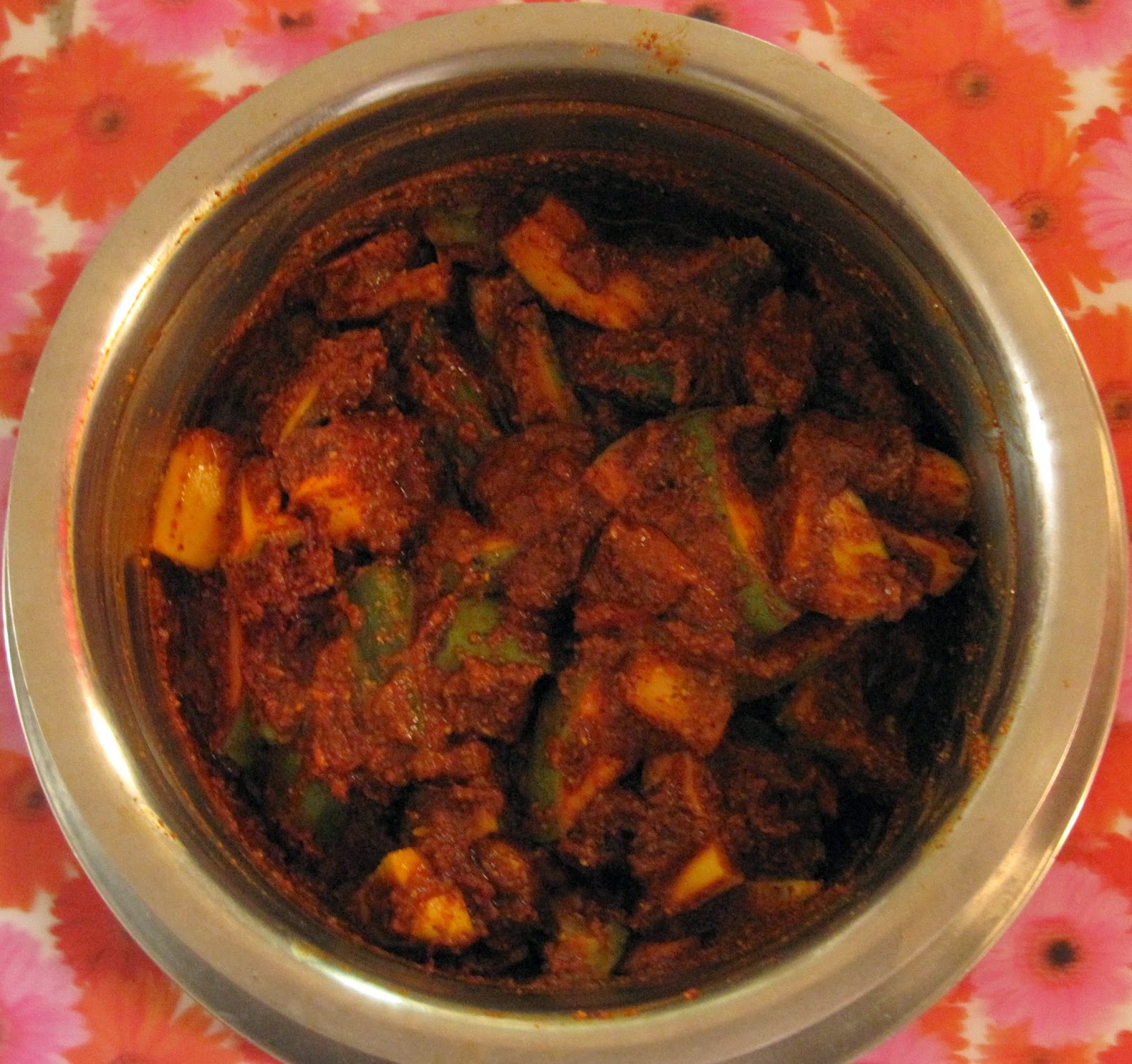
Kurala avakaya (Mixed vegetable avakaya)

This is a temporary pickle. It is a very popular pickle in our families. The recipe came down from my grandmother through my mother etc. Unlike the other mixed vegetable pickles where vinegar is used, here the ingredients are chili powder, mustard powder and salt which are used in our regular pickles. The vegetables mentioned below are used. Approximately the vegetable pieces are equal to the amount of mango pieces used. If refrigerated, the pickle stays for more than 2 or 3 months.
If the mango is not sour enough, you may add some citric acid. I have made the pickle in USA, adding rhubarb which is very sour and you do not need to add citric acid .
 
You can add green apple pieces also.
The vegetable pieces, specially bitter gourd taste very nice after they are soaked for a few days.


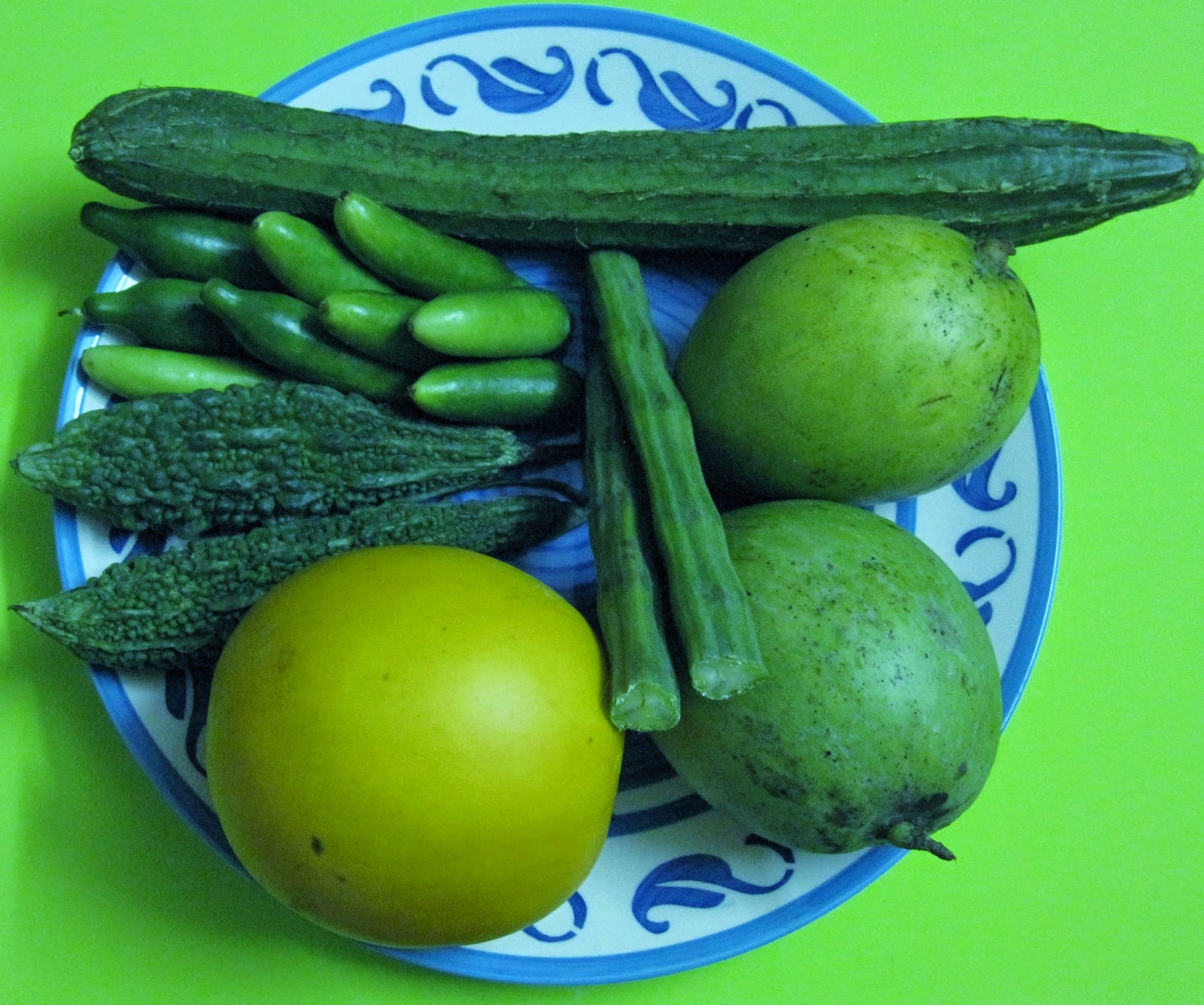
Vegetables used in kurala avakaya:


Vegetables cut into pieces:


Chili powder mixture added to the cut pieces:


Cut pieces and powders mixed well:


Ingredients:

All the following vegetable pieces to make upto 2 cups (equal to measure of mango pieces)
  •      2 cups mango pieces and
  •      Dosa kaya
  •      Beera kaya (Ridge gourd)
  •      Kakara kaya (Bitter gourd)
  •      Mulakkada (Drum sticks)
  •      Rhubarb (available in USA)
  •      2 tsp turmeric powder
  •      1 and 1/2 cups chili powder
  •      1 and 1/2 cups salt
  •      2 cups mustard powder
  •      1 cup oil
Seasoning:
  •      5 or 6 red chilis
  •      2 tbsp. chana dal
  •      2 tbsp. urad dal
  •      2 tbsp. mustard seeds
  •      1tsp  Hing (Asafetida)
  •      A few curry leaves

Directions:

  1.      Wash and dry all the vegetables.
  2.      Cut the mango with the peel and avoid cutting the seed portion.
  3.      Cut the vegetables along with peel into 1/2 inch wide and 1 and 1/2 inch long pieces. Remove seeds from dosa kaya.
  4.      For 2 cups of mango pieces, about 2 cups of all the other vegetables are needed.
  5.      Mix chili powder, mustard powder, salt and turmeric powder together in a large plate.
  6.      Add the vegetable pieces and mix well.
  7.      Add a few table spoons of oil and leave the mixture in a jar.
  8.      On the second day, mix it well from the bottom.
  9.      Heat oil in a pan and add chilis, dals and mustard seeds.
  10.      When mustard seeds crackle, add hing and curry leaves.
  11.      Pour the seasoning over the pickle mixture.
  12.      After an hour or so, mix the pickle well from the bottom.
  13.      Transfer the pickle to a clean dry jar.


Bellam avakaya (sweet and sour thoorpu avakaya)

This sweet and sour mango pickle with yellow chili powder is very popular in the coastal areas. It is more laborious to prepare, but, it tastes very good.

My mother and grandmother's generations, they used to cut the mangoes, so that they are not fully cut, but are joined at one end. The soft portion of the seed is fully scooped out and the chili mixture is stuffed inside the kernel. Then the whole procedure of soaking, drying etc is followed. The pieces are separated whenever they are served. All the children are given the job of cleaning, scooping out the seed portion etc. So, the pickle making used to involve everybody in the family. No wonder, pickle making is a ritual!!

Bellam avakaya freshly made:


Bellam avakaya about a month after it was made:


Mixture of chili powder, mustard powder and salt before jaggery is added:


Mango pieces mixed with chili mixture:


Mango pieces ready to be set aside:


Mango pieces in chili mixture with lot of juice:


Mango pieces dried in hot sun:


Ingredients:
 
  •      1 cup chili powder
  •      1 and 1/2 cups salt
  •      2 and 1/2 cups mustard powder
  •      5 cups powdered jaggery 
  •      2 to 3 cups oil
  •      3 to 4 tbsp. methi (fenugreek) seeds
  •      3 tsp turmeric powder

Directions:

  1.      Wash and dry the mangoes.
  2.      Cut them into 1 and 1/2 inch large pieces.
  3.      Remove the seed portion and remove the thin film sticking to the kernel.
  4.      Mix all the powders together.
  5.      Add some oil and mix the powder well.
  6.      Unlike for red avakaya, 2 and 1/2 containers of mango pieces are added to one container full of chili mixture.
  7.      Add the mango pieces to the chili mixture and place the mixture in a jar.
  8.      Cover and keep it in a cool dry place for 2 days.
  9.      Next day, there will be plenty of juice. As mango pieces mixed with salt and jaggery produce a lot of juice. Mix it from the bottom using a dry long spoon or using your hand.
  10.     On the third day, mix it well.
  11.     Squeeze the pieces to remove as much of the juice as possible.
  12.     Place all the pieces on a plastic sheet or steel plate and dry it directly in the sun.
  13.     Dry the juice also in the sun.
  14.     If the pickle is made in India, 2 or 3 days of sun drying is enough.
  15.     After the pieces are dried enough, they have to be placed back in the juice.
  16.     Mix it thoroughly and top it with some more oil.
Initially the pickle will have a lot of liquid, but, in course of time, the juice thickens.
When this pickle is eaten with hot rice and ghee, it tastes yummy!

Variation:

Those who like the taste and texture of bellam avakaya, but cannot get the yellow chili powder etc. make the variety using red chili powder.
Proportions for the avakaya are as follows:

  •      1 cup red chili powder
  •      1 cup salt
  •      1 cup mustard powder
  •      3 cups powdered jaggery
  •      2 or 3 tbsp. methi seeds
  •      2 tsp turmeric powder
  •      2 cups oil

The same procedure as followed for thoorpu avakaya is followed.

Notice the amount of jaggery powder is equal to the total amount of chili powder, mustard powder and salt together in both the recipes!


Avapacchadi (pulihora avakaya, mukkala pacchadi)

Ava pacchadi derives its name from the predominant ingredient "avalu" (mustard). It is also called "pulihora avakaya or mukkala pacchadi" as the pulihora seasoning is used in making this pickle. Many of my American friends like this pickle and comment that they are reminded of "wasabi" flavor!!

In Avakaya, equal portions of mustard powder and salt are used. In, Avapacchadi, more mustard powder is used. Because of this, the pickle has a more predominant flavor of mustard.

Usually, it is a byproduct, as the mango pieces which are without kernel (hard seed cover), or pieces that got squished while cutting are used,in addition to some fresh cut pieces!


Mustard paste after drying in direct sun:


Mixing mustard paste with mango mixture:                                                                                     


After mustard paste is mixed with mango mixture:


Ingredients:

  •      3 to 4 cups mango pieces
  •      1 and 1/2 cups chili powder
  •      2 cups mustard powder
  •      1 and 1/2 cups salt
  •      3 tsp turmeric powder

Seasoning:

  •      1 to 2 cups oil
  •      6 or 8 red chilis
  •      3tbsp chana dal
  •      4 tbsp. urad dal
  •      3 tbsp. mustard seeds
  •      a few curry leaves
  •      1 tsp hing (asafetida)

Directions:

  1.      Wash and dry mangoes thoroughly.
  2.      Cut along with skin into half inch cubes. Discard the seed.
  3.      Add turmeric powder, salt and chili powder.
  4.      Mix well and leave it in a dry container for a day.
  5.      Next morning, boil 2 cups of water. Turn off the heat.
  6.      Add mustard powder and mix well. Consistency has to be like dosa/pancake batter.
  7.      Leave it in the hot sun till evening.
  8.      Add the paste to the mango piece mixture.
  9.      By now, mango pieces will have some juice which oozes out after soaking in salt and chili powder.
  10.      Heat oil in a pan and add red chilis, dals and mustard seeds.
  11.      When mustard seeds splutter, add curry leaves.
  12.      Pour the seasoning over the pickle and let it seep through.
  13.      Partially cover the pickle.
  14.      Mix it well from top to bottom.
  15.      Transfer the pickle to a dry jar.


Pickle making -- Introduction


Pickles from Andhra Pradesh are well known all over. In the recent times, spice level is toned down, to suit to the present generation food habits. Measurements of ingredients cannot be exact, as they are dependent on the sourness of mangoes used. So, the best possible proportions are given. Also, amounts have to be adjusted according to the size of mangoes.

Mostly, the principal ingredients are the same, but procedural variations make the pickles different.
Sesame oil (gingely /til) is preferred for making the long term pickles. If in case, it is not available, you may use any other oil available locally.

Precaution:

It is preferred to use powdered rock salt rather than iodized salt.
My mother's and her earlier generations, used to buy red chilis, mustard seeds, dry them in the sun and and get them pounded in big stone or wooden pestles. Now, many people just buy the powders and use them.
Not too hot chili powder or mircha powder is preferred rather than very hot and spicy one.
In Andhra Pradesh, we prefer using Three Mangoes Chili powder or Joshi's Chili powder and mustard powder.
Now, ready mixed pickle masala is available in market. You have to just add mango pieces to the mixture and the pickle is ready in a jiffy!!!
While making pickles for the year, utmost care should be taken to see that the mangoes, utensils used, jars where the pickles are stored etc are absolutely dry.
Whenever mixing or transferring the pickles, hands and spoons also have to be dried thoroughly. The jars must be kept in a cool dry place and the jars have to be airtight.
Before starting pickle making, you have to get all the jars/bottles and all the vessels and spoons cleaned and dried.

Selection of mangoes:

In Andhra Pradesh, the process of selecting the mangoes, process of preparation, storage and serving the pickles is almost considered to be a ritual! The process is handed down from mother to daughter or mother-in-law to daughter-in-law!!

It is very important to pick the right variety of mangoes for pickle making. Mango must be mature with hard seed, firm and medium in size and sour. If the mangoes are not mature (hard seed is not developed), there is a chance that the pickle may not stay for long. When we were young, we used to get our mango supply from the village .The farmer used to say that the birds have started eating the mature mangoes. That is the indication that mangoes are ready to be picked for pickles. Parrots and other birds know when mangoes are mature!!  
It is necessary that the mangoes are raw and creamish in color when cut. The pieces must taste sour.
Taste and shelf life of the pickle is proportionate to the sourness!
Only mangoes which are directly plucked from the tree are to be used. Mangoes fallen to the ground may have some internal damage and the pickle may go bad.

In Andhra Pradesh pickle making starts from around last week of April. Most of the local vegetable markets have loads of mangoes heaped. The pickling season goes on till middle of May.

Cutting mangoes for avakaya is also a very difficult process. Every piece of mango has to have a part of the hard seed cover. If the pieces are squeezed while cutting, they are not used in the pickle. 

Each mango is cut into half. Then it is cut again into quarter. Every quarter piece is to be cut into 3 or 4 pieces according to your choice.

Professional cutters are available in the market to cut the mangoes into pieces. The instrument used to cut the mangoes has a firm handle on a butcher's knife and a firm base both joined at on end.

I am inserting some photographs of the process of cutting etc. 
I normally take a bucket and some clean water in bottles for soaking and cleaning the mangoes. After the mangoes are cleaned and dried, I spread an old sheet and get the mangoes cut on to that. I collect all the pieces in a dry container and bring them home for mixing.