Thursday, 31 August 2017

Vakkaya kobbari pacchadi ( Karuanda coconut chutney)

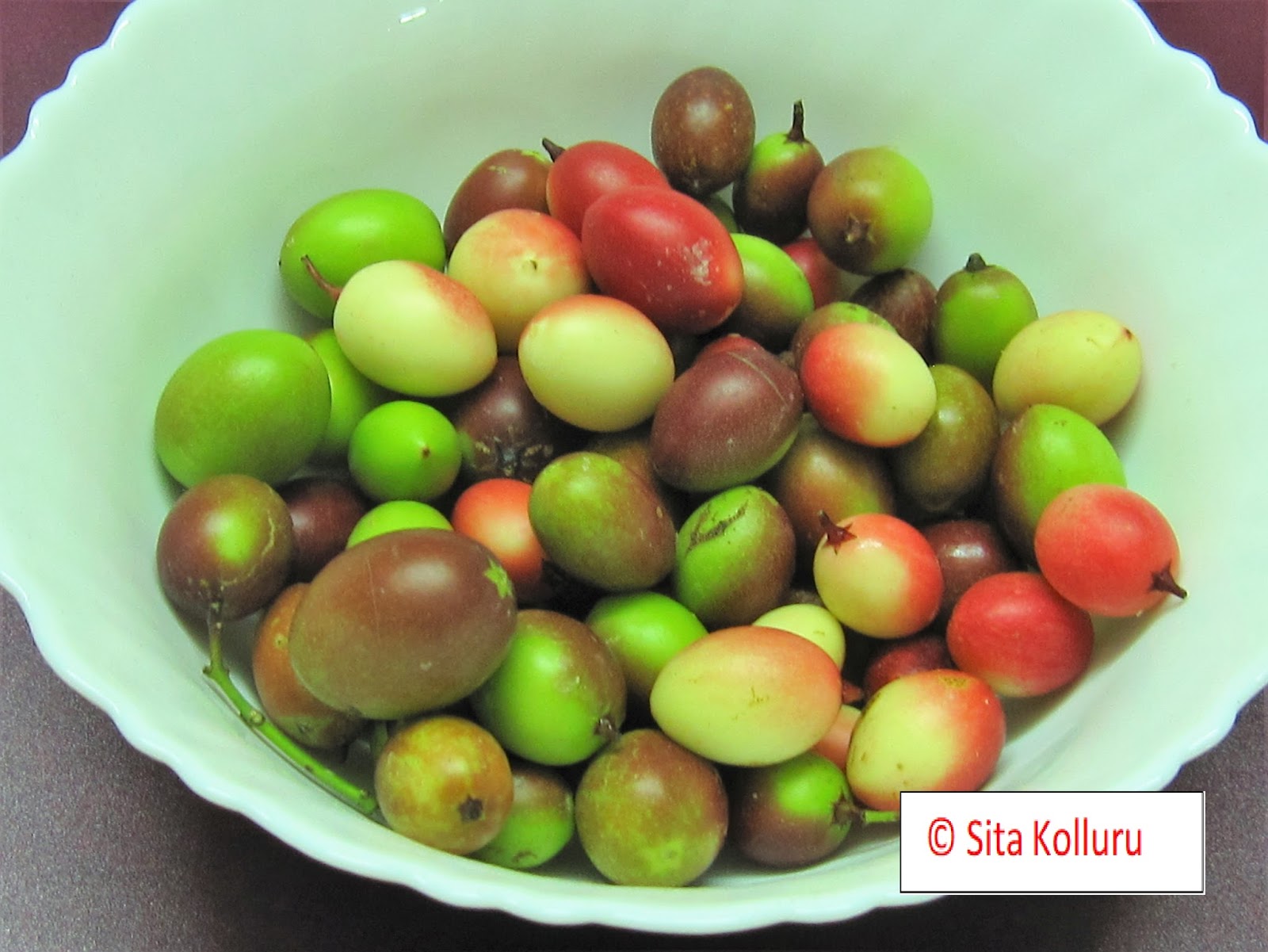
Vakkaya is well known as Karuanda in Hindi. It is also known as pickle berry! The fruit is quite tangy. Variety of chutneys and pickles are made using these fruits. Vakkaya contains pectin and accordingly is a useful ingredient in making jelly, jam and chutneys.

Vakkaya is a rich source of iron, so sometimes, it is used in treatment of anaemia. It contains a fair amount of Vitamin C. The fruits are available during monsoon season. Ripe fruits exude a white latex when severed from branch.

Vakkaya is very similar to cranberries, available in USA at Thanksgiving time. Many Indians who reside in USA, use cranberry as an equivalent to vakkaya.

Here is a recipe for making vakkaya coconut chutney. In USA, you get frozen, fresh grated coconut in many Indian stores. The tanginess of vakkaya along with fresh coconut makes a very yummy chutney.



Ingredients:
  •      1 cup vakkaya pieces
  •      1 or 1 1/2 cups fresh grated coconut 
  •      1/2 Tsp. turmeric powder
  •      1 Tsp. methi mustard powder
  •      Salt to taste
  •      1/2 Tsp. hing
  •      3 or 4 green chiles
Seasoning:
  •      2 Tsp. oil
  •      1 Tsp. mustard seeds
Directions:
  1.      Wash and cut karuanda.
  2.      Dry roast methi seeds and mustard seeds and grind them. (If you have methi mustard powder already made, you can avoid this step).
  3.      Place karuanda pieces in a mixie jar.
  4.      Grind so that the pieces are slightly mashed.
  5.      Add grated coconut, green chiles, salt, turmeric powder, mustard methi powder and hing.
  6.      Grind the mixture well. If needed, add a spoon of water.
  7.      Transfer to a serving dish or jar.
  8.      Heat oil in a small pan, add mustard seeds and hing. 
  9.      Add the hot oil to the preared chutney.
  10.      Vakkaya kobbari chutney is ready! 
  11.      The chutney is a nice side dish for rice, dosa, idli etc.

Tuesday, 29 August 2017

Aakakara kaya kura (Kakoda/Teasle gourd subzi)


Aakakara kaya, known as kakoda in Hindi is a species of flowering plant in the gourd family. It is known as Bristly balsam pear, spiny gourd or teasle gourd. Aakakara kaya is eaten in all regions of India and some parts of South Asia. In some parts of Andhra, it is known as boda kakara kaya also. This is a seasonal vegetable which is in markets during monsoon. 

The fruit has a lot of health benefits. Some of the benefits are reducing blood sugar levels, reducing chances of cancer, reducing excess sweating etc. Also, help in anti-aging, improving eyesight are some more benefits. High fiber content helps in easy digestion.


Ingredients:

  •      2 cups aakakara kaya pieces
  •      1/2 Tsp. turmeric powder
  •      1 Tbs. tamarind paste
  •      2 Tbs. jaggery pieces or powder
  •      1 Tsp. rice flour
  •      Salt to taste

Seasoning:


  •      2 Tsp. oil
  •      1 or 2 red chiles
  •      1 Tsp. urad dal
  •      1/2 Tsp. mustard seeds
  •      1/2 Tsp. jeera seeds
  •      Pinch of  hing (asafetida)
  •      Few curry leaves

Directions:


  1.      Wash and cut aakakara kaya in to discs or long pieces.
  2.      Remove seeds, if they are too hard and tough.
  3.      Boil water in a pan and add the pieces.
  4.      Add turmeric powder.
  5.      When the pieces are slightly soft, remove from heat.
  6.      Drain the water and set aside the pieces.
  7.      Heat oil in a thick pan.
  8.      Add red chile, urad dal, mustard seeds, and jeera seeds.
  9.      When mustard seeds splutter, add hing and curry leaves.
  10.      Add the cooked aakakara kaya pieces.
  11.      Mix well.
  12.      Add tamarind paste.
  13.      Keep stirring and add jaggery and rice flour.
  14.      Reduce flame and keep mixing.
  15.      Cook for five minutes and remove from heat.
  16.      Transfer to serving dish.
  17.      Can be eaten along with roti or rice.

Tuesday, 15 August 2017

Vakkaya (karuanda) pulihara (Rice flavored with vakkaya)

Vakkaya is well known as Karuanda in Hindi. It is also known as pickle berry! The fruit is quite tangy. Variety of chutneys and pickles are made using these fruits. Vakkaya contains pectin and accordingly is a useful ingredient in making jelly, jam and chutneys.

Vakkaya is a rich source of iron, so sometimes it is used in treatment of anaemia. It contains a fair amount of Vitamin C. The fruits are available during monsoon season. Ripe fruits exude a white latex when severed from branch.

Vakkaya is very similar to cranberries, available in USA at Thanksgiving time. Many Indians who reside in USA, use cranberry as an equivalent in many vakkaya recipes.


Ingredients:

  •      1/2 cup (approx) vakkaya (karuanda)
  •      2 cups cooked rice
  •      3 Tbs. oil
  •      2 or 3 green chiles
  •      1 Tsp. chopped ginger
  •      1/2 Tsp. turmeric powder
  •      Salt to taste


Seasoning:

  •      3 or 4  red chiles
  •      2 Tsp. chana dal
  •      1 Tsp. urad dal
  •      1 Tsp. mustard seeds
  •      Some hing (asafetida)
  •      Few curry leaves


Directions:


  1.      Cook rice in pressure cooker and let it cool. See that rice is not overcooked.    
  2.      Wash and cut vakkayalu (karuanda) either into 2 or 4 pieces.
  3.      Remove the seeds. It is easier to remove the seeds, if you place them in water for a few minutes after cutting.
  4.      Set the pieces aside.
  5.      Heat oil in a thick pan.
  6.      Add red chiles.
  7.      After a minute, add chana dal, urad dal and mustard seeds.
  8.      When mustard seeds splutter, add hing.
  9.      Add green chiles and ginger.
  10.      Add curry leaves.
  11.      Let the mixture cook for a few minutes.
  12.      Add karuanda pieces.
  13.      Keep stirring for a few minutes, till the pieces are slightly soft.
  14.      Add turmeric powder.
  15.      Mix well.
  16.      Add cooked rice and stir well.
  17.      Add salt.
  18.      Mix well, cover and let cook for 5 minutes.
  19.     Turn the heat off.
  20.     Pulihora (flavoured rice) tastes very nice if left to sit for some time.
  21.     Tastes nice along with raita or majjiga pulusu.


Vakkaya pappu ( Dal flavoured with vakkaya)


Vakkaya is well known as Karuanda in Hindi. It is also known as pickle berry! The fruit is quite tangy. Variety of chutneys and pickles are made using these fruits. Vakkay contains pectin and accordingly is a useful ingredient in making jelly, jam and chutneys.

Vakkaya is a rich source of iron, so sometimes it is used in treatment of anaemia. It contains afair amount of Vitamin C. The fruits are available during monsoon season. Ripe ffruits exude a white latex when severed from branch.

Either toor dal or moong dal or masoor dal can be used to make vakkaya pappu. As the fruits are tangy, the dal has a nice taste and flavour.


Ingredients:

  •      2 cups cooked dal
  •      1/2 cup vakkayalu cut in to quarters
  •      2 or 3 green chiles

Seasoning: 

  •      2 Tsp. oil
  •      2 red chiles
  •      1/2 Tsp. urad dal
  •      1 Tsp. mustard seeds
  •      1 Tsp. jeera seeds
  •      Pinch of hing
  •      Few curry leaves
  •      Cilantro for garnish

Directions:

  1.      Wash and cut vakkayalu in to two or four pieces.
  2.      Remove the seeds.
  3.      Cook dal in a pressure cooker.
  4.      Heat oil in a thick sauce pan.
  5.      Add red chiles.
  6.      After a minute, add urad dal. 
  7.      Keep stirring.
  8.      When urad dal is turning brown in color, add mustard seeds and jeera seeds.
  9.      Add hing.
  10.      Add half cup of water.
  11.      Add pieces of vakkayalu.
  12.      Let them cook for a few minutes.
  13.      See that the pieces are not overcooked.
  14.      Add green chiles and cooked dal.
  15.      Add salt, turmeric powder and a pinch of hing.
  16.      Let the mixture cook for five to ten minutes.
  17.      Add curry leaves and let cook.
  18.      After a few minutes, remove from heat.
  19.      Transfer to a serving dish and garnish with cilantro.


Saturday, 12 August 2017

Bisi beda bhat with korralu ( Bisi beda bhat with foxtail millet)

Foxtail millet, korralu have many health benefits. The tiny grain is gluten free and packed with nutrition. Korralu are high in calories which give lot of strength and energy. Millets supply magnesium, calcium, manganese, phosphorous, vitamins and antioxidants which are very essential for body fitness.

Korralu help in controlling diabetes, keeping digestive track clean, reducing risk of heart attack and reducing gastric problems.

In this recipe, I made bisi beda bhat with korralu. Traditionally, to male bisi beda bhat, we cook rice, dal, vegetables etc. in tamarind and spicy fluids. In place of rice, I have used korralu and the final product is delicious. Bisi beda bhat is a one dish meal.


Ingredients:

  •      1/2 cup toor dal
  •      1/3 cup korralu
  •      3 Tbsp. tamarind paste
  •      1/4 cup lauki pieces
  •      1 onion cut into pieces
  •      2 carrots cut into pieces
  •      3 or 4 drumstick pieces
  •      Few curry leaves
  •      1/4 Tsp. turmeric powder
  •      Pinch of hing
  •      2 Tsp. bisi beda masala or sambar powder
  •      2 Tsp. grated coconut (fresh or denydrated)
  •      Salt to taste

Seasoning:


  •      3 Tbsp. ghee
  •      1 Tsp. jeera seeds
  •      1 Tsp. mustard seeds


Directions:

  1.      Cook toor dal in a pressure cooker.
  2.      Wash and cut all vegetables.
  3.      Cook vegetables in a thick bottomed pan with enough water.
  4.      When the vegetables are partially cooked, add washed korralu, cooked dal and tamarind paste.
  5.      Add more water if needed.
  6.      Water must be enough to cook all the vegetables, along with korralu.
  7.      Add turmeric, hing and salt. Mix well.
  8.      Cover and pressure cook the mixture up to 3 whistles.
  9.      Open the cooker after the pressure is reduced and add more water, if needed.
  10.      Heat ghee in a small pan for seasoning.
  11.      Add jeera, mustard and hing.
  12.      When mustard seeds splutter, add the seasoning to the mixture.
  13.      Cook for a few minutes.
  14.      Add curry leaves.
  15.      Mix well.
  16.      Transfer to a serving dish.
  17.      Serve along with raita.


Wednesday, 26 July 2017

Mulaga aku pappu (Drumstick leaves dal)

Drumsticks which are popular ingredients in sambar or sweet pulusu etc. are commonly cooked in South India. Moringa, drumstick trees are native to Africa and Asia.

Many parts like immature seed pods (mulakkadalu/drumsticks), leaves, mature seeds and flowers of moringa are edible and have lot of health benefits.

Juice from Mulaga aku is believed to have stabilizing effect on BP and sugar levels. It is used to treat anxiety. 

The leaves are used to treat diarrhea, dysentery and colitis. Juice of leaves and carrots is used as diuretic. 

Leaves and buds are useful as external applications also to treat headache and skin infections. Leaves are helpful in killing intestinal worms.

Drumstick leaves are supposed to be good protein sources, vitamin C, calcium, vitamin A, and potassium. They are proving to be power houses of nutrients.

In India, drumstick trees are commonly grown in many places. Mulaga  leaves are available in some of the local markets. In USA, Indian stores in Seattle/Redmond, bunches of drumstick leaves are available.

Maybe keeping in view all the benefits, in Andhra Pradesh, it is customary to consume the leaves at least once during monsoon season. There are many recipes to make dal, chutney, spicy powder etc. Here is a recipe to make dal with drumstick leaves.


Ingredients:


  •      1 1/2 cups cooked toor dal
  •      1 cup mulaga aku (drumstick leaves)
  •      2 Tbsp. tamarind paste
  •      1/4 cup diced onion
  •      4 or 5 garlic pods
  •      1/2 Tsp. turmeric powder
  •      Salt to taste

Seasoning:


  •      2 red chiles
  •      2 Tsp. oil
  •      1 Tsp mustard seeds
  •      1 Tsp. jeera seeds
  •      1/2 Tsp. hing (asafetida)


Directions:


  1.      Cook toor dal in a pressure cooker.
  2.      Separate the leaves from stems.
  3.      Wash and clean the leaves thoroughly making sure that there are no bugs sticking to the leaves.
  4.      Chop onions finely.
  5.      Peel garlic pods.
  6.      Heat oil in a thick saucepan.
  7.      Add red chile.
  8.      Stir and add jeera and mustard seeds.
  9.      When mustard seeds splutter, add hing.
  10.      Add chopped onions.
  11.      Stir well.
  12.      When onions are translucent, add garlic.
  13.      Keep stirring.
  14.      Add drumstick leaves.
  15.      Mix well.
  16.      Cook for 3 to 4 minutes.
  17.      Add cooked dal.
  18.      Add tamarind paste and some water.
  19.      Add turmeric, hing and salt.
  20.      Let the mixture cook for 5 to 6 minutes. 
  21.      Add enough water till you get the required consistency.
  22.      Cook for a few minutes.
  23.      Transfer to a serving dish.
  24.      A good side dish for roti or rice.


Saturday, 22 July 2017

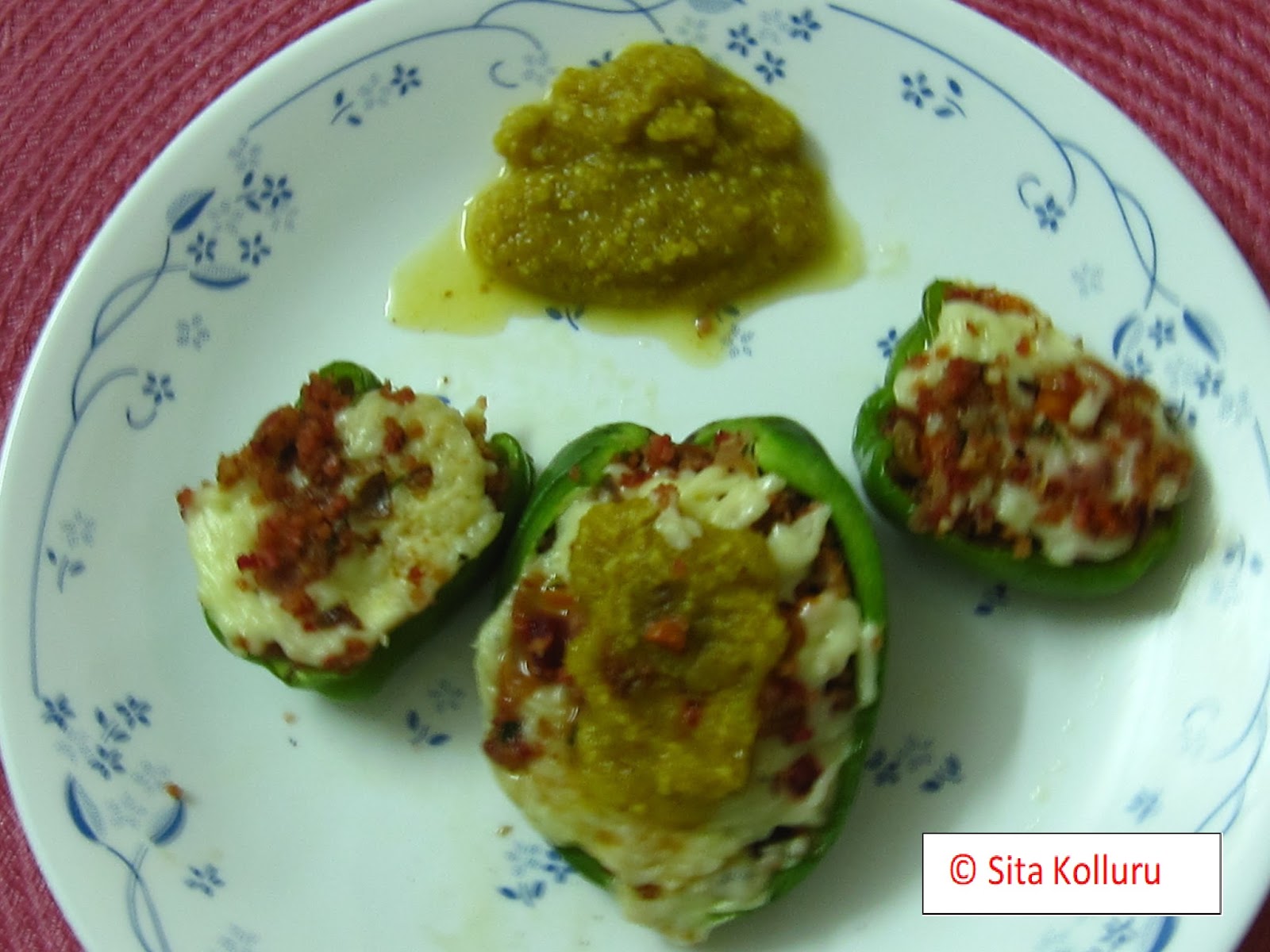
Capsicum (bell pepper) stuffed with Korralu (foxtail millet) and vegetables

Millets are a group of variable small-seeded grasses widely grown around the world. Millets are important crops in the semiarid tropics of Asia and Africa. Mostly widely grown are sajjalu (pearl millet) which is an important crop in India and parts of Africa.

Fox millet, korralu have many health benefits. This tiny grain is gluten-free and packed with nutrition. Even though it is called a grain, millet is actually a seed. Korralu are high in calories, thus giving strength and energy. Korralu are rich in proteins, and very low in fat.

Millets are full of nutrients your body needs, such as, magnesium, calcium, manganese, phosphorus vitamins and antioxidants. Millets do not have any fiber and sugar in any form. Consuming organic korralu has more benefits as they are free of pesticide residues.

Korralu is a good diabetic food and a replacement for rice. Unlike rice, millets release glucose steadily without affecting the metabolism of the body.

Recently lot of rice eaters are switching to millets and quinoa etc. Some interesting recipes with millets are being experimented. In this post I have tried to stuff bell peppers with korralu cooked along with vegetables and bake/microwave or pan fry. Instead of korralu, we can use either  cooked rice or noodles. Go ahead and try out.


Ingredients:

  •      5 or 6 bell peppers (medium or small sized)
  •      1/2 cup chopped onion
  •      1/3 cup finely chopped carrots
  •      1/3 cup finely chopped beetroot
  •      1/3 cup green peas
  •      2 finely chopped green chiles
  •      1 cup cooked korralu (foxtail millet)
  •      1/2 cup grated cheese
Seasoning :
  •      1/2 Tsp. jeera seeds
  •      1/4 Tsp. turmeric powder
  •      1 Tsp. garam masala
  •      1/2 Tsp. chili powder
  •      Salt to taste
  •      3 Tsp. oil
Directions:
  1.      Cook about 1/3 cup millets in either pressure cooker or on stove top.
  2.      Let it cool and set aside.
  3.      Wash and clean capsicum.
  4.      Cut into half and deseed.
  5.      Heat oil in a thick pan.
  6.      Add jeera seeds.
  7.      Cook for 2 minutes,
  8.      Add chopped onion, let it cook till onion pieces are translucent.
  9.      Add chopped carrot, beetroot and green peas.
  10.      Keep stirring.
  11.      Add chile powder, garam masala and salt.
  12.      Stir well and cook till the vegetables are soft to touch.
  13.      Add cooked millets.
  14.      Let the mixture cook for 5 minutes.
  15.      Let it cool.
  16.      Fill the capsicum halves with the mixture.
  17.      Top the stuffed capsicum with grated cheese.
  18.      Place the capsicum on a baking sheet and bake them in an oven.
Instead of baking, you can pan fry the stuffed capsicum:
  1.       Heat oil in a thick pan.
  2.       Carefully place the capsicum in the pan taking care that they do not flip.
  3.      Cover and cook on very low heat.
  4.      Carefully move the capsicum so that they do not get burnt.
  5.     When the capsicum is soft to touch and the cheese melts, transfer to a serving plate.
To microwave:
  1.      Place the capsicum in a microwave safe flat dish.
  2.      Microwave on medium heat till the skin is soft to touch.