Showing posts with label Millets in Indian cooking. Show all posts

Wednesday, 10 April 2019

Korralu idli (Foxtail millet idli)

Millets are cereal crops and small seed grasses. There are many varieties of millets like Jowar (Sorghum), Korralu (Foxtail millet), Ragi (Finger millet), Bajra (Pearl millet), Barnyard millet, Kodo millet, Little millet and Proso millet.

Millets are important crops in semiarid tropics of Asia and Africa, with 97% of millet production in developing countries. The crop is favored due to its productivity and short growing season under dry, high-temperature conditions.

Gluten free millets can play a pivotal role in curing several health issues. Millets are a rich source of fiber, minerals like magnesium, phosphorous, iron etc. They are extremely nutritious and good for health.

Millets are good for coronary diseases. By including millets in daily diet, one can manage sugar levels. Millets promote digestion. Foxtail millet helps in detoxification. The presence of iron and calcium in foxtail millet helps in strengthening immunity.

A word of caution, though. Excessive consumption of millet might cause an adverse effect. Millets contain goitrogen, a substance that interferes with the production of thyroid hormones and inhibits iodine uptake and utilization by the thyroid gland. This may lead to the development of enlarged thyroid gland, known as goiter. Goiter causes dry skin, anxiety, depression and slow thinking.


Ingredients:

  •      1 cup whole urad without skin
  •      4 cups korralu (foxtail millet)
  •      1 Tsp. fenugreek seeds
  •      2 Tbsp. flat rice (atukulu) (optional)
  •      Salt to taste
  •      2 or 3 Tsp. grated carrot
  •      A few coriander leaves
  •      Idli making vessel or idli plates which can be placed in a cooker.


Directions:

  1.      Soak urad dal in water for overnight.
  2.      Add the fenugreek seeds.
  3.      Soak korralu (millets) in plenty of water.
  4.      Drain the water.
  5.      Grind small amounts of the dal finely in a grinder trying to avoid adding additional water.
  6.      When the dal is finely ground, add the drained millet in small amounts.
  7.      Process the mixture for a few minutes.
  8.      Wash the flat rice and add to the mixture.
  9.      Grind for 2 minutes.
  10.      Check the consistency of the mixture.
  11.      Millets should not be ground fine.
  12.      The mixture must feel like sooji or rava to touch.
  13.      Grind all the dal and millets and mix thoroughly.
  14.      Add salt and mix well.
  15.      Cover and leave the batter in a warm place, for the batter to ferment.
  16.      Like idli/dosa batter, in a few hours, the batter ferments and you can see the bubbles and the quantity raise.
  17.      Pour about a cup of water in the idli maker or cooker.
  18.      Grease the idli plates.
  19.      Pour 2 spoons of batter in each mold. garnish with grated carrot and cilantro leaves.
  20.      Place the idli stand in the cooker and cover.
  21.      If using the pressure cooker, the pressure knob need not be placed.
  22.      Cook for about 8 minutes after steam starts coming up.
  23.      Remove from heat and let it cool for 4 to 5 minutes.
  24.      Take the idli plate outside and using a wide spoon or a blunt knife, carefully spoon out the idlis into a serving plate.

 Adding flat rice while grinding, helps in getting soft textured idlis.


Saturday, 12 August 2017

Bisi beda bhat with korralu ( Bisi beda bhat with foxtail millet)

Foxtail millet, korralu have many health benefits. The tiny grain is gluten free and packed with nutrition. Korralu are high in calories which give lot of strength and energy. Millets supply magnesium, calcium, manganese, phosphorous, vitamins and antioxidants which are very essential for body fitness.

Korralu help in controlling diabetes, keeping digestive track clean, reducing risk of heart attack and reducing gastric problems.

In this recipe, I made bisi beda bhat with korralu. Traditionally, to male bisi beda bhat, we cook rice, dal, vegetables etc. in tamarind and spicy fluids. In place of rice, I have used korralu and the final product is delicious. Bisi beda bhat is a one dish meal.


Ingredients:

  •      1/2 cup toor dal
  •      1/3 cup korralu
  •      3 Tbsp. tamarind paste
  •      1/4 cup lauki pieces
  •      1 onion cut into pieces
  •      2 carrots cut into pieces
  •      3 or 4 drumstick pieces
  •      Few curry leaves
  •      1/4 Tsp. turmeric powder
  •      Pinch of hing
  •      2 Tsp. bisi beda masala or sambar powder
  •      2 Tsp. grated coconut (fresh or denydrated)
  •      Salt to taste

Seasoning:


  •      3 Tbsp. ghee
  •      1 Tsp. jeera seeds
  •      1 Tsp. mustard seeds


Directions:

  1.      Cook toor dal in a pressure cooker.
  2.      Wash and cut all vegetables.
  3.      Cook vegetables in a thick bottomed pan with enough water.
  4.      When the vegetables are partially cooked, add washed korralu, cooked dal and tamarind paste.
  5.      Add more water if needed.
  6.      Water must be enough to cook all the vegetables, along with korralu.
  7.      Add turmeric, hing and salt. Mix well.
  8.      Cover and pressure cook the mixture up to 3 whistles.
  9.      Open the cooker after the pressure is reduced and add more water, if needed.
  10.      Heat ghee in a small pan for seasoning.
  11.      Add jeera, mustard and hing.
  12.      When mustard seeds splutter, add the seasoning to the mixture.
  13.      Cook for a few minutes.
  14.      Add curry leaves.
  15.      Mix well.
  16.      Transfer to a serving dish.
  17.      Serve along with raita.


Saturday, 22 July 2017

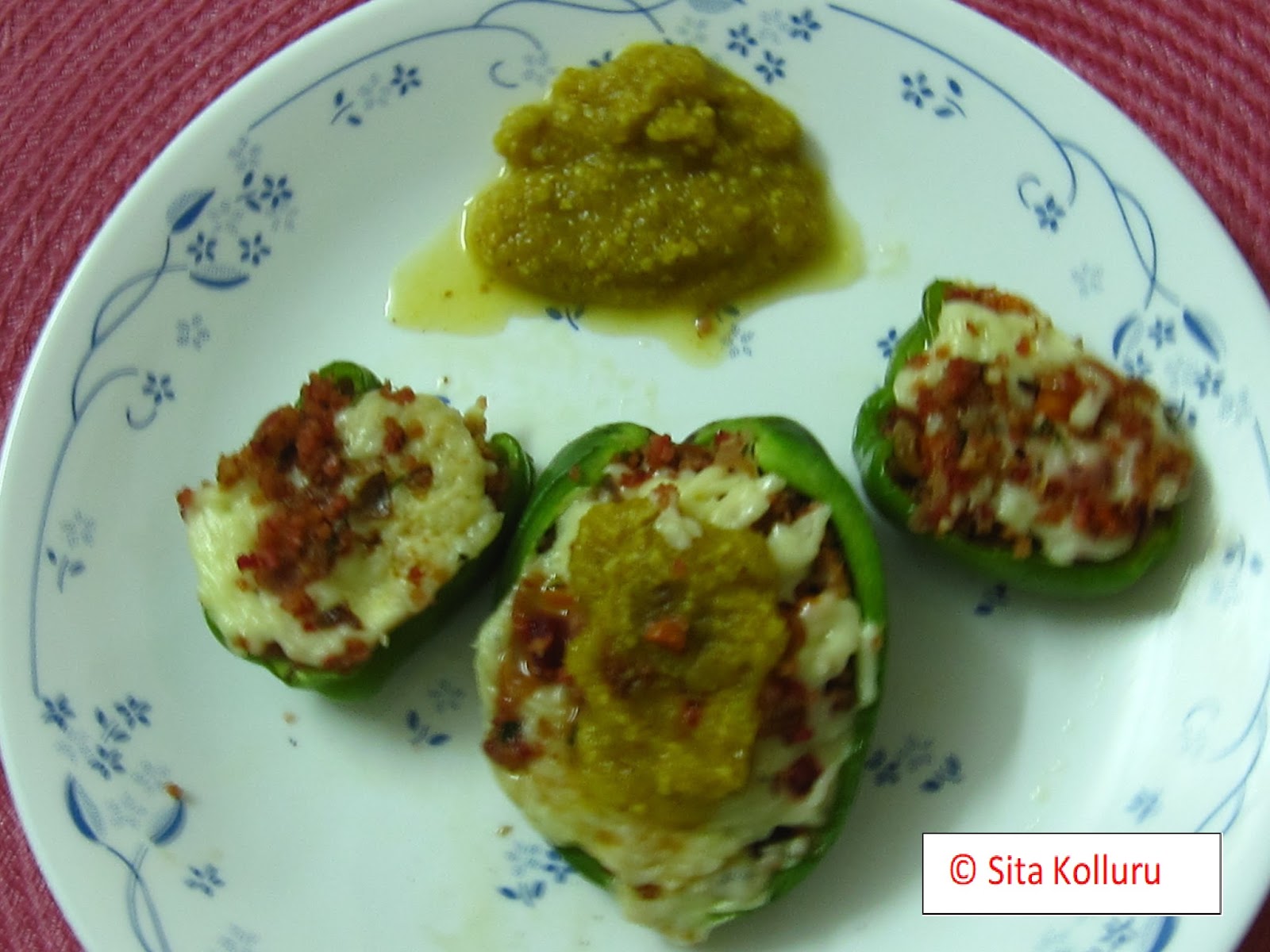
Capsicum (bell pepper) stuffed with Korralu (foxtail millet) and vegetables

Millets are a group of variable small-seeded grasses widely grown around the world. Millets are important crops in the semiarid tropics of Asia and Africa. Mostly widely grown are sajjalu (pearl millet) which is an important crop in India and parts of Africa.

Fox millet, korralu have many health benefits. This tiny grain is gluten-free and packed with nutrition. Even though it is called a grain, millet is actually a seed. Korralu are high in calories, thus giving strength and energy. Korralu are rich in proteins, and very low in fat.

Millets are full of nutrients your body needs, such as, magnesium, calcium, manganese, phosphorus vitamins and antioxidants. Millets do not have any fiber and sugar in any form. Consuming organic korralu has more benefits as they are free of pesticide residues.

Korralu is a good diabetic food and a replacement for rice. Unlike rice, millets release glucose steadily without affecting the metabolism of the body.

Recently lot of rice eaters are switching to millets and quinoa etc. Some interesting recipes with millets are being experimented. In this post I have tried to stuff bell peppers with korralu cooked along with vegetables and bake/microwave or pan fry. Instead of korralu, we can use either  cooked rice or noodles. Go ahead and try out.


Ingredients:

  •      5 or 6 bell peppers (medium or small sized)
  •      1/2 cup chopped onion
  •      1/3 cup finely chopped carrots
  •      1/3 cup finely chopped beetroot
  •      1/3 cup green peas
  •      2 finely chopped green chiles
  •      1 cup cooked korralu (foxtail millet)
  •      1/2 cup grated cheese
Seasoning :
  •      1/2 Tsp. jeera seeds
  •      1/4 Tsp. turmeric powder
  •      1 Tsp. garam masala
  •      1/2 Tsp. chili powder
  •      Salt to taste
  •      3 Tsp. oil
Directions:
  1.      Cook about 1/3 cup millets in either pressure cooker or on stove top.
  2.      Let it cool and set aside.
  3.      Wash and clean capsicum.
  4.      Cut into half and deseed.
  5.      Heat oil in a thick pan.
  6.      Add jeera seeds.
  7.      Cook for 2 minutes,
  8.      Add chopped onion, let it cook till onion pieces are translucent.
  9.      Add chopped carrot, beetroot and green peas.
  10.      Keep stirring.
  11.      Add chile powder, garam masala and salt.
  12.      Stir well and cook till the vegetables are soft to touch.
  13.      Add cooked millets.
  14.      Let the mixture cook for 5 minutes.
  15.      Let it cool.
  16.      Fill the capsicum halves with the mixture.
  17.      Top the stuffed capsicum with grated cheese.
  18.      Place the capsicum on a baking sheet and bake them in an oven.
Instead of baking, you can pan fry the stuffed capsicum:
  1.       Heat oil in a thick pan.
  2.       Carefully place the capsicum in the pan taking care that they do not flip.
  3.      Cover and cook on very low heat.
  4.      Carefully move the capsicum so that they do not get burnt.
  5.     When the capsicum is soft to touch and the cheese melts, transfer to a serving plate.
To microwave:
  1.      Place the capsicum in a microwave safe flat dish.
  2.      Microwave on medium heat till the skin is soft to touch.