Showing posts with label dry subzi.. Show all posts

Monday, 1 October 2018

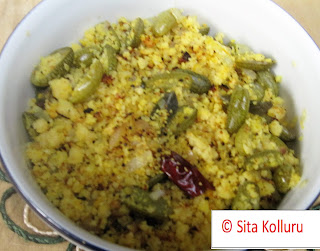
Sandita (cucamelon) patholi with dal paste steamed (Andhra) (Sandita patholi with steamed moong dal paste)

Patholi in Andhra cuisine refers to a dry subzi. The main ingredient is either yellow split dal, pesara pappu (moong dal) or chana dal or toor dal, soaked for about an hour and ground to a coarse paste. The ground paste is added to any vegetables like cluster beans, kundru, sandita, or leafy vegetables like methi (fenugreek) or drumstick leaves and pan fried. Patholi is a popular side dish for either steamed rice or roti. Usually it is served along with buttermilk pulusu or raita.

Patholi is known by different names in different parts of India eg. paruppu usili in Tamil Nadu, or a popular Malvani dish Vatli dal in Maharashtra, Goa and Konkan region. In Goa and Konkani cuisine, patoli is a steamed sweet dish with rice flour, coconut and jaggery wrapped in turmeric leaves!!

Coming to making of patholi from Andhra Pradesh, this is a different version from the one I posted earlier. In this version, the ground dal mixture is steamed like idli and then the idlis are either grated or processed in a vegetable processor.  This process is less oil consuming. You can prepare more of the dal mixture and store in a freezer to use later. The dish looks nice and appealing.


Ingredients:


  •      1 cup moong dal (split green dal without skin)
  •      1 cup sandita (cucamelon)
  •      1 small onion
  •      2 or 3 red chiles
  •      1 Tsp. mustard seeds
  •      2 Tsp. jeera seeds
  •      Pinch of asafetida
  •      3 Tbsp. oil
  •      A few curry leaves
Directions:
  1.      Soak moong dal in enough water for one hour.
  2.      Drain the water and grind in a blender with one or two red chiles and some jeera seeds.
  3.      Avoid adding any water, as much as possible.
  4.      The mixture can be coarsely ground.
  5.      Prepare idlis with this batter using an using idli plates.
  6.      Cool the idlis and either process them in a vegetable processor or grate them manually.
  7.      Set aside the mixture.
  8.      Wash and cut sandita in to quarter pieces.
  9.      Peel and dice the onion.
  10.      Heat oil in a thick deep pan.
  11.      Add red chile to the hot oil.
  12.      After a minute, add mustard and jeera seeds and mix.
  13.      Add asafetida.
  14.      When mustard seeds splutter, add curry leaves.
  15.      Add onion pieces and sauté till they turn translucent.
  16.      Add sandita and mix well. 
  17.      Cook for 3 to 4 minutes till they are partly cooked.
  18.      When the pieces are soft, add the dal mixture.
  19.      Add salt.
  20.      Keep stirring and cook on low heat for 5 to 6 minutes.
  21.      Turn off the heat and keep it covered for a few minutes.
  22.      As the dal mixture is already cooked, time taken to finish the dish is less than time taken in the traditional procedure.
  23.      Popular combination for this subzi is Roasted eggplant chutney or raita
  24.      In fact, the prepared mixture can be kept in small packs in the freezer and used anytime.


dondakaya patholi (Andhra) (Kundru/tindora/gherkin moong dal patholi)

Patholi in Andhra cuisine refers to a dry subzi. The main ingredient is either yellow split pesara pappu (moong dal) or chana dal or toor dal, soaked for about an hour and ground to a coarse paste. The ground paste is added along with spices to any sautéed vegetable and cooked for a few minutes. Patholi is a popular side dish for either steamed rice or roti and usually served along with raita or pacchadi or.maggiga pulusu.

Patholi is known by different names in different parts of India eg. paruppu usili in Tamil Nadu, or a popular Malvani dish vatli dal in parts of Maharashtra, Goa and Konkan region. In Goa and Konkani cuisine patoli is a steamed sweet dish with rice flour, coconut and jaggery wrapped in fresh turmeric leaves!!

Now, coming to Andhra patholi, there are different versions of how to make the same dish. I will try to give the recipes for different versions. Many vegetables like cluster beans, kundru, sandita (cucamelon), asparagus, methi leaves (fenugreek greens), or mulaga aku (drumstick leaves) can be used in making patholi.

In this recipe, I have used dondakaya (kundru) and moong dal. After grinding the dal with spices, I added the wet paste to the sauteed kundru and cooked along. In this method, you need to add more oil to get the nice texture and taste.


Ingredients:

  •      1 cup moong dal (split green dal without skin)
  •      1 cup  dondakaya
  •      2 or 3 red chiles
  •      1 Tsp. mustard seeds
  •      2 Tsp. jeera seeds
  •      Pinch of asafetida
  •      3 Tbsp. oil
  •      A few curry leaves.


Directions:

  1.      Soak moong dal in enough water for 1 hour.
  2.      Drain the water and grind dal in a blender with one or two red chile and jeera seeds.
  3.      Avoid adding water as much as possible.
  4.      The mixture can be coarsely ground.
  5.      Set aside the ground paste.
  6.      Wash and cut dondakayalu in to small long pieces.
  7.      Heat oil in a thick pan.
  8.      Add red chile to the hot oil.
  9.      After a minute, add mustard and jeera seeds and mix.
  10.      Add asafetida.
  11.      When mustard seeds sputter add curry leaves.
  12.      Add dondakaya pieces and cook while stirring often.
  13.      When the pieces are getting soft, add the dal mixture, using your palm, so that it is kind of sprinkled.
  14.      Add salt and keep stirring.
  15.      Reduce the heat and let it cook for 5 to 10 minutes.
  16.      Moong dal will give a nice aroma and the wetness from the mixture will be gone.
  17.      Turn the heat off.
  18.      Cover and let it stay for a few minutes.
  19.      A nice main dish for rice or quinoa or roti.
  20.      A popular combination for this subzi is  (Roasted egg plant chutney) Vankaya pulusu pacchadi or kheera raita


Monday, 4 July 2016

parwal kothimira karam kura

Parwal is ethnic to India (esp North) and is not available elsewhere. It is easily available in North and Eastern India.  Even in South India, it was not available earlier.  Parwal resembles kundru (dondakaya/gherkin/coccinia). Parwal is a seasonal vegetable available in summer season.
Parwal is easy to digest and so recommended for patients with weak digestion, jaundice etc.

Many varieties of subzi are made using parwal with different ingredient combinations. Aloo parwal (parwal with potato) is a very popular and favorite one!

I am giving a subzi which is less time consuming and tasty as well!


Ingredients:

  •       8 or 10 parwal
  •       1/2 cup kothimira (cilantro) cleaned and chopped
  •       2 or 3 green chiles  (according to taste)
  •       Salt to taste
  •       2 or 3 tsp. oil

Directions:

  1.      Cut parwal in quarter lengthwise.
  2.      Grind cilantro, chiles and salt together in a grinder.
  3.      Heat oil in a pressure cooker.
  4.      Add parwal pieces and cilantro masala.
  5.      Add two or three spoons of water.
  6.      Mix well, cover and cook for one or two whistles.
  7.      Remove the lid when the pressure comes to normal.
  8.      Cook for 4 to 5 minutes till water evaporates.
  9.      Serve with rotis or rice.


Monday, 15 September 2014

Panasa pottu kura (Jackfruit dry subzi)

The Jackfruit is native to parts of South and Southeast Asia, and is believed to have originated in the Southwestern rain forests of India, in present-day Kerala and coastal Karnataka and Maharashtra. Its fruit is the largest tree-borne fruit reaching as much as 80 pounds (36kgs) in weight, 36 inches in length and 20 inches in diameter.
The Jackfruit tree is widely cultivated in tropical regions. Jackfruit is national fruit of Bangladesh.
The flesh of the jackfruit is starchy and fibrous and is a source of dietary fiber. The flavor is comparable to a combination of apple, pineapple, mango and banana.
This is a famous Coastal Andhra dish and mostly a must on the menu during auspicious occasions. The jackfruit is cut or processed in such a way, you cannot identify the vegetable. The jackfruit used is young and unripe and special knives are available to cut it fine like shreds or saw dust which is called "pottu".

Caution:
Before touching the raw jackfruit for cutting,  spread 2 or 3 newspapers, grease both hands generously with sesame (til) oil or use gloves. When we cut jackfruit, it leaves a milk like latex which is very sticky. It leaves stains as well. It is important to prevent spoiling the floor, your hands and your dress!!
Cut the jackfruit into two pieces. Then remove the thorny green skin part and the hard
core (center part) and chop into small cubes. Grease your hands frequently while you are cutting the vegetable.

In Andhra Pradesh fresh panasa pottu is available in market.
In USA, jackfruit pieces are available in cans in Indian stores and Asian markets.
If using pieces, place the pieces in a food chopper or processor, add a pinch of turmeric and a spoon of oil and process it.


Ingredients:

2 cups of processed jackfruit
1 tsp turmeric powder
Salt to taste
Small ball of tamarind (optional)

For seasoning:

2 tsp urad dal
1 tsp chana dal
1 tsp mustard seeds
2 or 3 green chilis finely cut
1 inch ginger finely cut
A few curry leaves
A pinch  hing
2 tsp lemon juice
3 tsp mustard powder  (or mustard paste)
3 tbsp. kura vadiyalu (dehydrated urad vadiyams)
Oil for seasoning

Directions:

Place jackfruit in a microwave safe bowl, add turmeric powder and put the tamarind ball inside the jackfruit and add a few spoons of water.
Cook partially covered for 4 minutes.
Stir and cook again for 3 to 4 minutes.
Deep fry vadiyams and set them aside
In the same oil, fry dals and mustard seeds.
When mustard splutters, add chili and ginger pieces.
Add hing and curry leaves.
Add the cooked jackfruit and salt.
Keep stirring for a few minutes.
Turn the heat off. Add mustard powder or paste and lemon juice.
Mix thoroughly. Garnish with vadiyams and serve.

Note:

If using mustard paste, grind mustard seeds with a few spoons of water and a pinch of turmeric. Add the paste to the subzi. Otherwise,, mustard powder can be used.