Tuesday, 28 April 2020

Tomato/ Mixed vegetable soup

Soups are a good way to get a lot of different ingredients in one meal. In 60s and 70s soup powders, cubes etc. were not available to purchase. During winter, when tomatoes and other vegetables were available in plenty, soup was a choice food as an appetizer for cold evenings!

Many of the vegetables and spices included in soup recipe are immune boosters. Tomatoes, carrots, beetroot etc. are recommended for the anti-oxidants. Spices like ginger, garlic, black pepper are
anti-inflammatory and anti-fungal.

I do not remove tomato skins and seeds when I make it unless I make it for company. If preferred, you may soak tomatoes in boiling water and remove the peels.

Similarly, for thickening, I add some masoor dal (lentils) instead of corn flour or maida. Another option is to add 2 Tbsp. sago (tapioca) and cook for 10 to 15 minutes.

Basically, this recipe is for a common soup. According to choice and availability many other vegetables can be added. If preferred, you may add grated carrots, peas or sweet corn while boiling after blending the mixture. You can add cooked pasta also.

Many soup recipes sauté some spices etc. and boil the rest of vegetables. Similarly, some people prefer fresh cream as topping. I try to avoid oil and fresh cream for health reasons. If you prefer, you may add fresh cream.

Now in many markets, soup packets are available. But store-bought soups can be high in sodium. Fresh homemade soups have their own flavors! 


Ingredients:

  •      8 or 10 medium size tomatoes
  •      1 cup diced carrots
  •      1 cup diced beetroot
  •      1/2 cup chopped cilantro
  •      2 medium onions chopped
  •      3 or 4 garlic pods
  •      1/2 inch ginger chopped
  •      2 Tbsp. masoor dal
  •      2 or 3 Tsp. black pepper powder
  •      2 Tsp. sugar (optional)
  •      Salt to taste

Directions:

  1.      Wash and cut tomatoes in to half.
  2.      Peel and chop carrots and beetroot.
  3.      Peel and chop onions.
  4.      Add a cup of water to a pressure cooker.
  5.      Add tomatoes, chopped vegetables, onion, garlic and cilantro,
  6.      Add ginger pieces.
  7.      Add washed masoor dal.
  8.      Cook the mixture for one or two whistles.
  9.      Let the mixture cool to room temperature.
  10.      Place the mixture in a blender and make thick liquid.
  11.      If you want the soup clear and without tomato skins, seeds etc. Sieve the liquid through a soup strainer.
  12.      Add more water to your preferred consistency.
  13.      Boil the mixture in a thick bottomed pan.
  14.      Add fresh ground pepper, salt and sugar (if preferred).
  15.      Cook for 10 to 15 minutes.
  16.      If you have bread slices or croutons you may add some on your soup before serving.
  17.      If preferred, you can add some grated carrot, green peas etc. and cook the mixture.
  18.      Or, you may add some cooked pasta to the soup. 
  19.      Serve hot.


Monday, 20 April 2020

Charu (Rasam/lentil soup); Rasam powder

Charu or rasam is a spicy soup made in South India using tamarind juice or lemon juice, black pepper, tomato, cumin, turmeric and other spices. Vegetables like drumsticks (moringa) etc are added to enhance the taste or flavor and nutrition. Tomato rasam is one of the most popular types. Rasam is eaten along with rice or drunk like soup. For many South Indians, rasam is a comfort food.

Rasam is a staple food in the main course in every South Indian home.

Rasam has a lot of health benefits.

Traditional rasam mainly contains tamarind, which is rich in fibre, rich in antioxidants etc. Many of the spices added like coriander seeds, black pepper, fenugreek and cumin are all good for digestion and acid control. Thus, eating/drinking rasam helps in controlling flatulence and cures constipation.

As rasam is easily digested, rasam is a preferred dish for pregnant women, convalescing patients, for introducing solid food to babies etc.!

Rasam is rich in minerals and vitamins.

Black pepper content of rasam powder is what helps in respiratory problems also. It promotes removal of toxins by making the body sweat and produce more urine.

I prefer rasam where all the ingredients are blended together. Some people like to have the tomatoes as pieces and cilantro as garnish. Both the versions taste good.

Now, when the whole world is fighting against, virus COVID-19, eating/drinking rasam is a popular dish in many households. Rasam improves a person's immunity level.

You need to add Rasam Powder, which is available in many Indian stores. But under the present circumstances, the stores may not be open and also may not have all the supplies. In South India, every household has a recipe of its own for rasam powder. So, I have given here a recipe for making Rasam powder that I have liked.  If you do not want to make a whole lot of the powder, you may reduce the amounts of the ingredients proportionately and make the powder. It can be stored in an airtight jar or saved in the freezer so that the flavor is kept fresh.


Ingredients:
  •      1/4 cup toor dal or masoor dal
  •      2 or 3 tomatoes
  •      1 cup cilantro (chopped)
  •      1 Tbsp. tamarind paste or
  •      3 Tsp. lemon juice
  •      2 Tsp. rasam powder
  •      Salt to taste
  •      1/2 Tsp. turmeric powder
  •      1/4 Tsp. asafetida
  •      Curry leaves for garnish
Directions:
  1.      Wash and put the dal in pressure cooker
  2.      Wash and cut the tomatoes in half.
  3.      Wash and chop cilantro.
  4.      Add tomatoes and cilantro to dal.
  5.      Add about 1 cup or more water.
  6.      Cook the mixture in pressure cooker for three whistles.
  7.      Remove from heat and let cool.
  8.      If using tamarind (not paste or powder), soak tamarind in hot water.
  9.      Squeeze tamarind and sieve the juice.
  10.      Set aside.
  11.      When the cooked mixture is cool, blend the mixture in a grinder. 
  12.      Transfer the ground mixture to a deep pan.
  13.      Add salt, rasam powder, turmeric powder and asafetida.
  14.      Add tamarind juice/paste/powder.
  15.      (If lemon juice is preferred, do not add the juice now).
  16.      Cook the mixture for 5 to 10 minutes.
  17.      If using lemon juice, stop cooking and add lemon juice.
  18.      Garnish with curry leaves and cilantro.
  19.      Serve with steamed rice or serve it like soup in a cup or bowl.
Rasam powder:

Ingredients:
  •      1 cup toor dal (Pigeon peas)
  •      1 cup dhania (Coriander seeds)
  •      1/4 cup chana dal (Chick pea) 
  •      1 Tbsp. jeera seeds (Cumin)
  •      1 Tbsp. methi seeds (Fenugreek)
  •      1 Tbsp. mustard seeds 
  •      1 Tbsp. miriyalu (Black pepper) (more if you want spicy rasam)
  •      1/4 cup dried curry leaves
  •      Red chiles (optional)
  •      2 Tsp. hing (Asafetida)
Directions:
  1.      Heat a thick pan.
  2.      Do not add any oil.
  3.      Roast red chiles for 3 to 4 minutes.
  4.      Transfer the chiles to a plate.
  5.      Add toor dal and keep mixing.
  6.      When the dal is turning brown and has a nice aroma, transfer the dal to a plate.
  7.      Add coriander seeds to the pan and heat.
  8.      Keep stirring till there is a nice aroma.
  9.      Transfer to the same plate.
  10.      Add methi seeds and roast for 2 or 3 minutes.
  11.      Add mustard seeds, jeera seeds, and black pepper to the same pan.
  12.      Mix well.
  13.      Add asafetida.
  14.      Finally add dried curry leaves.
  15.      Mix well and remove from heat.
  16.      When the mixture is cool, put the mixture in a mill or grinder and powder it.
  17.      The powder can be stored in an airtight jar or packed in zip lock bags and stored in a freezer.


Saturday, 4 April 2020

Colored capsicum stuffed with paneer and rice (Colored bell peppers stuffed with paneer and rice)

During the trying times, when, we see, hear, or think only of Covid-19, I wanted to divert myself and try to upload a healthy and nutritious recipe. Of course, the dish looks colorful also, lifting my spirits!

Peppers are native to Mexico, Central America and Northern South America. Peppers are available in many colors, including red, yellow, orange, green, white and purple. Bell peppers are sometimes grouped with less pungent pepper varieties as "sweet peppers". While they are fruits - botanically classified as berries, they are used as a vegetable in salads, sandwiches and pizzas etc.

Colored peppers like red, orange and yellow peppers are full of great health benefits. They are packed with vitamins and are low in calories! They are an excellent source of vitamin A, C and also potassium. Bell peppers contain a healthy dose of fiber, folate and iron.

Red peppers contain more than 200 percent of one's daily vitamin C intake.

Red bell peppers help support healthy night vision.

Res bell peppers are packed with antioxidants.

In this dish, I tried filling sauteed vegetables mixed with crumpled paneer and cooked rice.

The filled peppers are topped with grated cheese and cooked.

Stuffed bell peppers are a well-balanced nutrient dish.

Rich in protein, carbohydrates and vitamins, vitamin A from colored capsicums, folic acid and  antioxidant lycopene from tomato and calcium from paneer,


Ingredients: 
  •      3 or 4 colored capsicum
  •      1/2 cup cooked rice
  •      1/2 cup paneer crumpled
  •      2 Tbsp. diced carrot
  •      2 Tbsp. diced onion
  •      2 Tbsp. 1 Tbsp. cilantro (finely chopped)
  •      2 Tbsp. green peas (frozen or fresh)
  •      2 Tbsp. pizza sauce (homemade or readymade)
  •      3 Tbsp. oil
  •      1 Tsp. jeera seeds
  •      Salt to taste
  •      1 Tsp. chile powder
  •      1 Tsp. garam masala
  •      1 Tsp. oregano or Italian seasoning
  •      Grated cheese for topping
Directions:
  1.      Wash and dry bell peppers.
  2.      Cut the top and remove seeds from inside.
  3.      Now the peppers look like cups.
  4.      If any left over rice is available, it may be used.
  5.      Wash and cut all the vegetables for stuffing.
  6.      Any available vegetables may be used for stuffing.
  7.      Heat 2 Tsp. oil in a thick deep pan.
  8.      Add jeera seeds.
  9.      Cook for a minute.
  10.      Add diced onions.
  11.      Stir well.
  12.      Cook for 2 minutes, when onions are turning translucent, add diced carrot.
  13.      Mix well and add all the other vegetables you like.
  14.      Let cook while stirring well.
  15.      Add chile powder, garam masala, oregano and salt.
  16.      Mix well.
  17.      When the vegetables are cooked, add crumples paneer.
  18.      Mix well. Cook for 2 minutes.
  19.      Add the rice.
  20.      Cook for a minute and remove from heat.
  21.      Add finely cut cilantro.
  22.      Add pizza sauce and mix thoroughly so that all the ingredients get a coat of the spices.
  23.      Fill the peppers with the vegetable and rice mixture.
  24.      Top with some grated mozzarella cheese.
  25.      Heat a pressure cooker, add 2 Tsp. oil.
  26.      When the cooker is hot, place the bell peppers in the cooker.
  27.      Sprinkle 2 or 3 spoons of water.
  28.      Cover the cooker and cook up to one whistle.
  29.      Remove the lid when the pressure is down.
  30.      Check whether the peppers are soft to touch.
  31.      If needed, cook for a minute or two.
  32.      Serve hot.
  33.      This happens to be a single dish which is a wholesome meal.


Sunday, 16 February 2020

Kamal kakadi dry subzi with dahi ( Lotus root/stem dry subzi with yogurt)

Kamal kakadi/lotus stem/lotus root is the root of the lotus plant. The rhizomes of lotus are consumed as a vegetable in many Asian countries, extensively in China and Japan. They have a crunchy texture with sweet tangy flavors. In North India they are easily available. In South India lotus stem is not a common vegetable. I notice that it is sometimes available in online stores. In USA many Asian markets sell them in cut pieces fresh, frozen or canned.

Kamal kakadi or lotus stem/root is very popular in North Indian cuisine. The lotus root is fried or cooked in subzis, soups, salad or pickled in vinegar (with sugar, chile and garlic). Subzi made with kamal kakadi as the main ingredient and including eggplant, potato and palak (spinach) is highly significant in Sindhi weddings and is a part of wedding meal!

Kamal kakadi is packed with an array of nutrients that promote health. It is rich in dietary fiber, potassium, iron and vitamin B and C. Considering they have these important nutrients and minerals, lotus stem/root can be called as one of the healthiest foods!

Lotus stems/roots boost digestion and reduce constipation problems.

The presence of potassium and iron prevent excessive sodium and increase blood circulation and also increase production of urine, which prevents excessive water retention.

Lotus stems have vitamin B complex, which interacts with neural receptors in the brain which reduces stress.

Kamal kakadi is good for skin and hair and promotes weight loss as this vegetable not only has lesser calories, but packed with fiber which makes one feel full for a longer period.

As lotus stems or kamal kakadi are harvested from under water, they need a thorough cleaning before cooking. Sometimes after cutting the stems in 6 or 8 inch tubes, you may have to use ear buds to clean the holes inside the tube!

Here is a recipe where I used dahi (yogurt) along with the masala. The final dish has a unique flavor and tastes very nice.


Ingredients:

  •      1 cup cut lotus stem (about 2 sticks of stem)
  •      1/2 Tsp. chile powder
  •      1/2 garam masala
  •      1/2 oil
  •      2 Tsp. jeera seeds
  •      1/4 Tsp. asafetida
  •      1/2 cup curd (yogurt)
  •      1 Tbsp. dhania seeds (coriander seeds)
  •      1 Tbsp. ginger
  •      2 Tbsp. fresh grated coconut
  •      Cilantro for garnish.

Directions:

  1.      Soak the lotus stems in water for fifteen or twenty minutes.
  2.      Scrub the outer surface and clean thoroughly.
  3.      Repeat washing and cleaning till the stem looks clean.
  4.      Peal the outer skin of the kakadi.
  5.      Cut the stems in diagonal slices.
  6.      Cook the slices in pressure cooker for one or two whistles.
  7.      Let the pressure cooker cool.
  8.      Remove the slices from water, drain and press slightly so that they are dry.
  9.      Grind together dhania seeds, some jeera and grated coconut.
  10.      Add curd to the mixture and grind together.
  11.      Add the ground paste to the slices.
  12.      Add salt, chile and garam masala powders.
  13.      Mix well.
  14.      Heat oil in a thick pan.
  15.      Add jeera seeds and asafetida and mix well.
  16.      When the seeds splutter, add the slices.   
  17.      Cook on high heat for 5 to 6 minutes till the liquid thickens.
  18.      Transfer to a serving bowl.
  19.      Garnish with cilantro and serve.


Monday, 10 February 2020

Gongura pappu (Gongura flavored dal)


Gongura is a leafy vegetable, which is very famous in India, especially in Andhra Pradesh. Gongura comes in two varieties, green stemmed leaf and red stemmed. The red stemmed variety is sourer than green stemmed one. 

Gongura has many health benefits as it has lots of fiber. The leaves are a rich source of iron, vitamin A, C, and B6. The leaves have calcium, iron and Gongura contains a lot of antioxidants essential for human nutrition. Gongura is rich in essential minerals like calcium, potassium, phosphorous, magnesium and iron. 

As gongura has all the above minerals etc. consuming gongura improves digestive health, prevents cancer and anemia, helps in keeping heart healthy and lowers blood pressure.

Many tasty dishes like chutney, dal, flavored rice etc are prepared. The most popular dish is of course pickle type of chutney. Because of the tangy taste, many non vegetarian dishes like gongura chicken, gongura mutton etc are very popular. I have prepared gongura dal which is very healthy and tasty.


Ingredients:
  •      1 cup toor/masoor dal
  •      1 cup gongura leaves
  •      2 or 3 green chiles
  •      2 or 3 Tbsp. onions chopped
  •      8 or 10 garlic pods
  •      1/2 Tsp. turmeric powder
  •      Salt to taste
Seasoning:
  •      2 Tsp. oil
  •      2 red chiles
  •      1 Tsp. urad dal
  •      1 Tsp. mustard seeds
  •      1 Tsp. jeera seeds
  •      Pinch of hing (asafetida)
Directions:
  1.      Wash and dry gongura plants.
  2.      Pinch the leaves and separate them from stems.
  3.      Chop the leaves coarsely.
  4.      Wash and cook the dal in pressure cooker.
  5.      When the cooker gets to normal pressure, open the lid.
  6.      Add oil to a heated thick bottomed pan.
  7.      Add red chile and stir well.
  8.      After a minute, add urad dal, jeera and mustard seeds.
  9.      Mix well.
  10.      When mustard seeds splutter, add gongura leaves and chopped onion.
  11.      Add 1/2 cup water.
  12.      Let it cook for 3 to 4 minutes.
  13.      Remove cooked dal from cooker.
  14.      Mash the dal roughly.
  15.      When onion pieces are cooked, add the dal.
  16.      Add turmeric powder, and salt.
  17.      Add green chiles.
  18.      Cook for 5 to 6 minutes, stirring well.
  19.      Heat oil in a small pan.
  20.      Add garlic and saute for a few minutes.
  21.      When garlic pods are turning brown, add them to the cooked dal.
  22.      Cook for 2 minutes. 
  23.      Remove from heat. 
  24.      Transfer to a serving dish.
  25.      Tastes tangy and nice. Can be served with rice or roti.


Monday, 6 January 2020

Beerakaya pottu pacchadi (Ridge gourd/Taroi peel chutney)

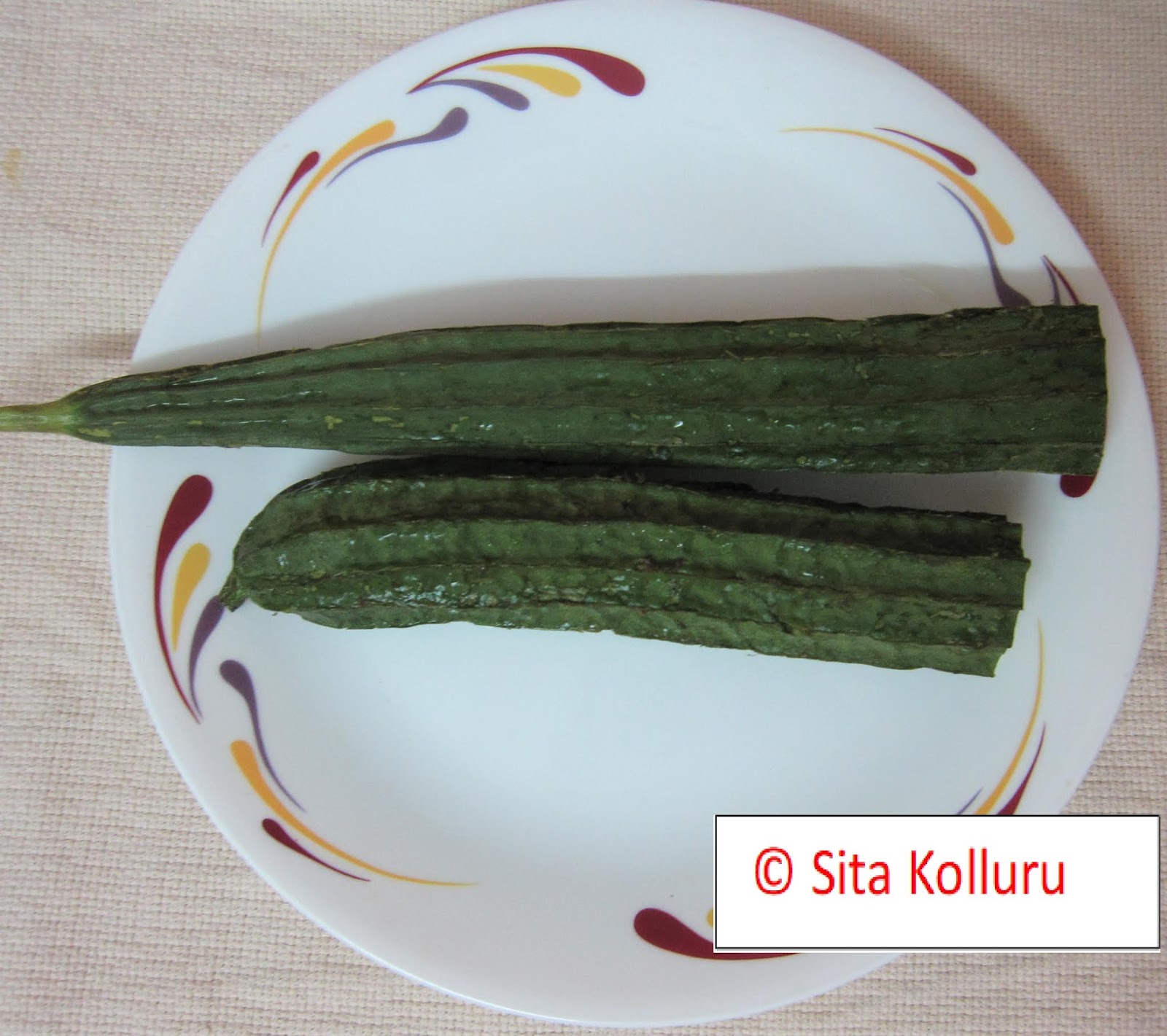
Beerakaya or taroi as it is known in Hindi is Ridge gourd or sponge gourd. It is referred to as Luffa also. It is a ridged and dark green vegetable with white pulp inside. The fruit of this species is eaten as a vegetable. This vegetable is popular in India, China and Vietnam.

When the fruit is fully ripened, it is very fibrous. The very ripe fruit is dehydrated and processed to remove everything except the network of fibers. The fibrous skeleton is marketed as luffa or loofah sponge, which is used as a body scrub, or scrubbing sponge for kitchen cleaning etc.

For edible purposes, the gourd has to be very tender, before hard seeds and fiber develop. The taste of the vegetable resembles zucchini.

Beerakaya has a lot of health benefits. some of the benefits are as below.

It is rich in dietary fiber and includes vitamin C, zinc, iron, riboflavin, magnesium etc. The vegetable is low in saturated fat, cholesterol and calories which aids in weight loss. Taroi contains good amount of cellulose and high in water content that helps to relieve from constipation. Some more benefits are reducing sugar levels, improving eye sight, purifying blood etc.

In Andhra beerakaya is a popular sick diet for convalescent people or young mothers after delivery etc. A variety of subzis, dals, chutneys etc. are made using beerakaya. Here is a recipe for a tasty chutney. In this chutney, the main item is the peel of the vegetable. The chutney is full of fiber. Also, the healthy peel is not discarded. Adding walnuts enhances both the taste and nutritive value of the chutney.


Ingredients:


  •      1 cup beerakaya peel
  •      1/2 cup diced beerakaya
  •      2 Tbsp. walnuts
  •      2 Tsp. oil
  •      2 or 3 green chiles
  •      1 Tsp. red chile powder
  •      1/2 Tsp. turmeric powder
  •      Salt to taste
  •      1 Tsp. mustard methi powder
  •      2 Tsp. lemon juice
  •      Cilantro

Seasoning:

  •      1 Tsp. oil
  •      1 Tsp. mustard seeds
  •      1/2 Tsp. chana dal
  •      1/2 Tsp. urad dal
  •      Pinch of hing (asafetida)

Directions:

  1.      Wash and peel beerakaya (taroi/ridge gourd)
  2.      Save the peel.
  3.      Finely chop the peel.
  4.      If very little peel is available, some diced beerakaya can be added.
  5.      If you are using lot of the beerakaya for some other subzi etc. only the peel itself can be used.
  6.      Heat oil in a thick pan.
  7.      Add the peel and the diced pieces.
  8.      Let it cook on low heat for 4 to 5 minutes.
  9.      When the pieces are all soft to touch, stop cooking.
  10.      Let the mixture cool.
  11.      Add the walnut pieces, green chiles, some cilantro and the powder ingredients and grind in a mixer.
  12.      Add lemon juice and mix well.
  13.      Transfer to a bowl.
  14.      Heat oil in a pan for seasoning.
  15.      Add dals and mustard seeds and pour the hot seasoning over the chutney.
  16.      Garnish with cilantro and serve.


Note:  Adding walnuts is optional. The taste and nutritive value are enhanced by the addition of walnuts. In place of walnut, roasted sesame seeds can be added.


Sunday, 17 November 2019

Gummadikaya (kaddu) halwa (Red pumpkin halwa)

Gummadikaya (pumpkin) is a popular vegetable in many countries.

In India all over the country gummadikaya is available. In many areas it is used in festive occasions like weddings and house warming functions. Either a subzi or a pulusu (mixed vegetable sweet and sour stew) cooked with pumpkin is definitely served in festive lunches.

Similarly in North America and Canada pumpkin pie is a traditional part of Thanksgiving meals. From middle of September, one finds many kinds of pumpkins all over USA. Pumpkins have a lot of significance in Halloween folklore.

Pumpkin leaves, flowers and seeds are edible.

Pumpkin has a lot of medicinal value also. Pumpkin is highly nutritious and very rich in vitamin A.
It is contains high amount of antioxidants and may reduce risk of chronic diseases and boost immunity. Pumpkin is high in nutrient density and low in calories. Consuming pumpkin may help in weight loss.

Some people may be allergic to pumpkin. Also, it is mildly diuretic, which means eating a lot of pumpkin may induce production of more urine.

In USA and Canada you find pumpkin pie, pumpkin bread and even pumpkin latte! In India lot of subzis and sweets are made with pumpkin. Here is a recipe for pumpkin halwa. Very little sugar and ghee (clarified butter) are used, so that it is not overly rich!

This festive season, try out this halwa for your holidays!


Ingredients:


  •      3 cups grated pumpkin
  •      3/4 cup sugar 
  •      1 or 2 Tbs, sooji (cream of wheat)
  •      2 Tbs. ghee (clarified butter)
  •      2 Tbs. cashew nuts
  •      1 Tbs. raisins
  •      4 or 5 green cardamom 

Directions:

  1.      Wash and cut the pumpkin in half.
  2.      Remove seeds and inside pulp.
  3.      Peel the skin off.
  4.      Either you can grate them  or
  5.      Cut in to one inch pieces.
  6.      Process the pieces and a vegetable chopper.
  7.      Grind in a powder grinder or pestle and mortar cardamom seeds.
  8.      Heat a thick pan. 
  9.      Add ghee.
  10.      When the ghee melts, add cashews and cook for 2 minutes.
  11.      When cashews are turning brown, add raisins.
  12.      Remove them from the pan and set aside.
  13.      To the same pan, add sooji.
  14.      Keep stirring so that sooji is not burnt.
  15.      After 2 or 3 minutes, add grated/processed pumpkin.
  16.      On low heat cook for 5 to 6 minutes.
  17.      Keep stirring.
  18.      When the moisture is almost evaporated, add sugar.
  19.      After adding sugar, more moisture will be there.
  20.      Keep stirring till the mixture becomes compact and leaves the sides and bottom of the pan.
  21.      When touched, the mixture does not stick to the fingers.
  22.      At this stage, the halwa is ready.
  23.      Add cardamom powder and nuts.
  24.      Mix well. 
  25.      Transfer to serving bowl and serve hot.
  26.      Tastes nice whether eaten hot or refrigerated.